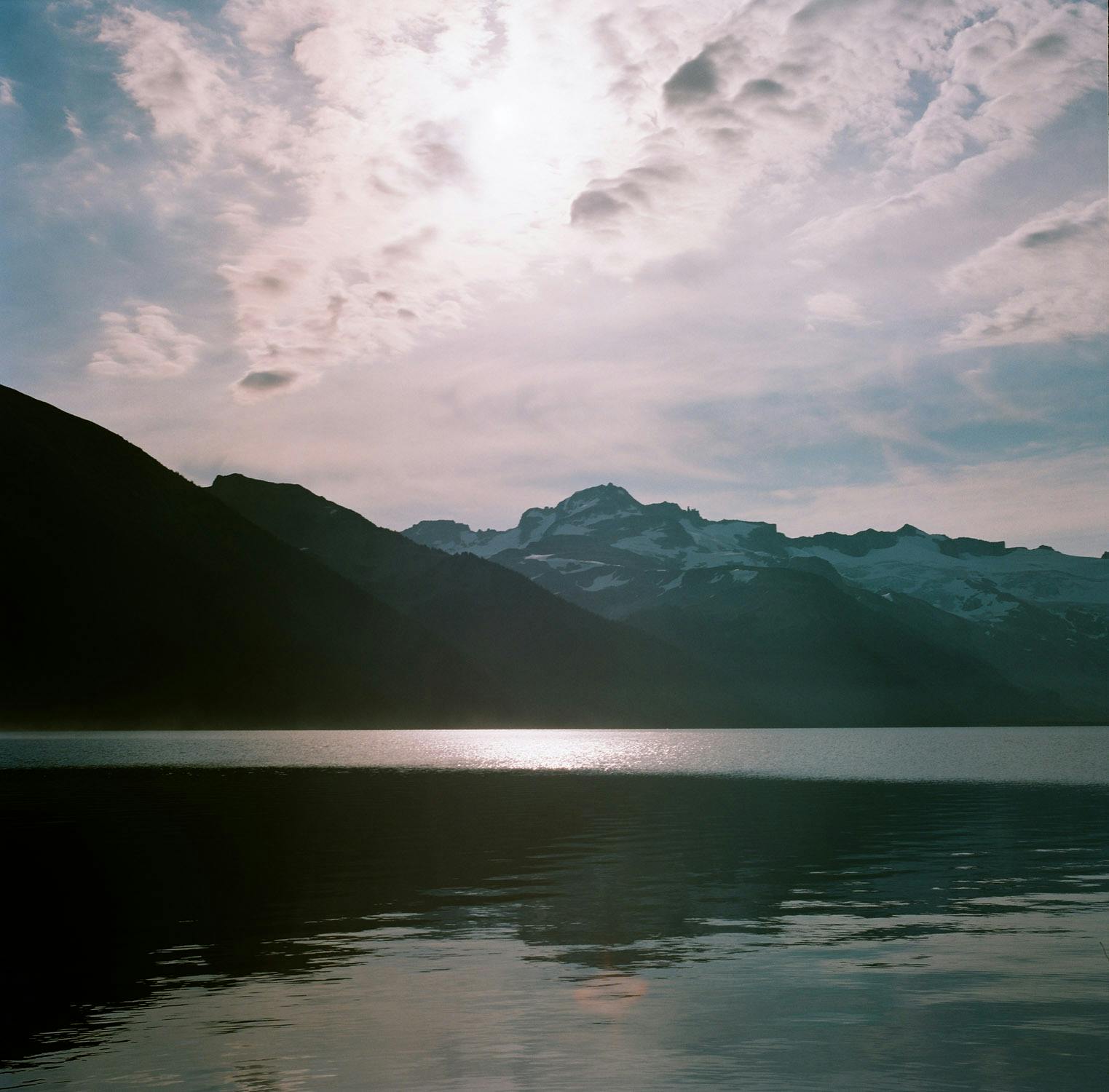
New Film Captures BC’s Other-Worldly Oyster Beds
Documentary explores intersections of labour, landscape, marine life, and climate.

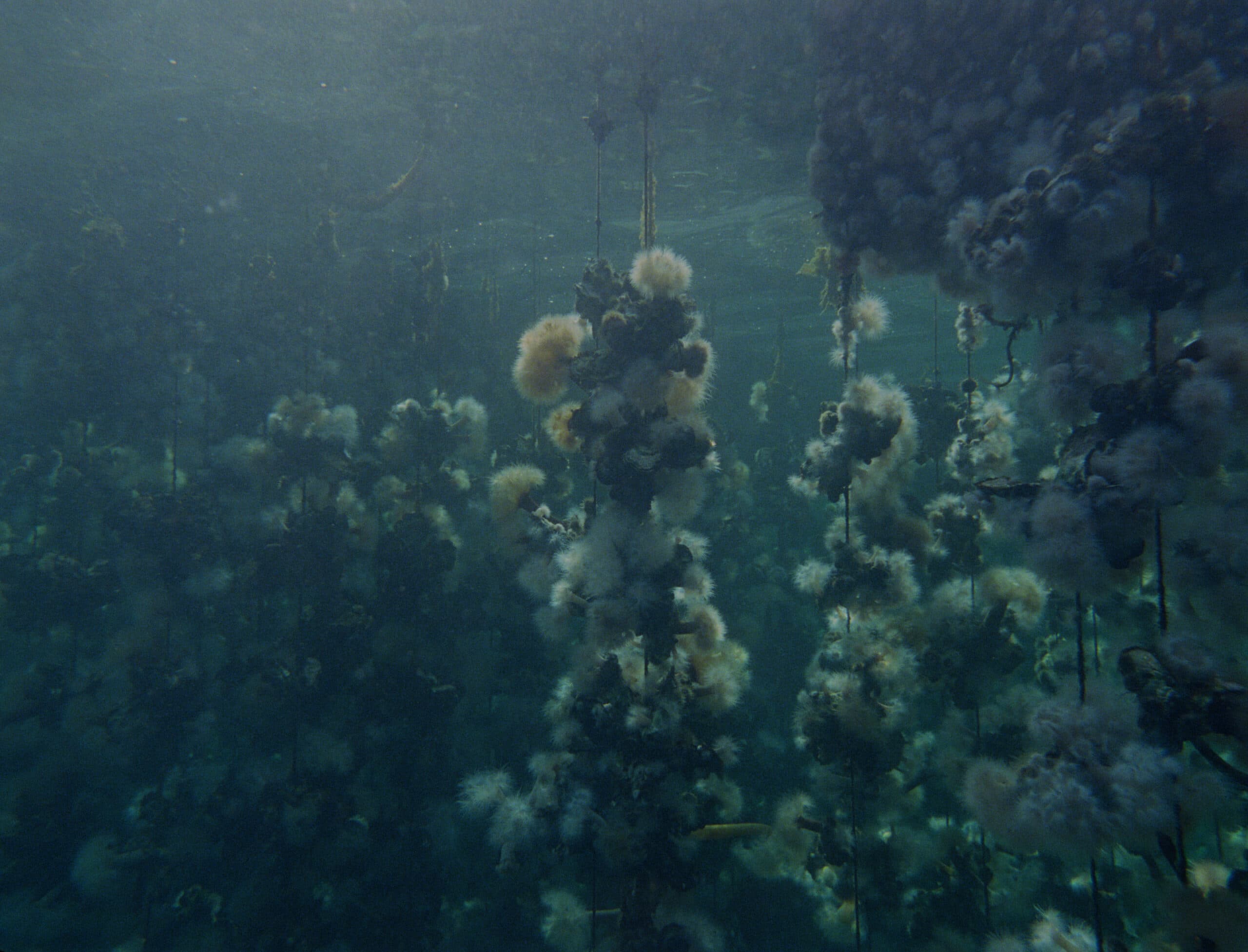
Oysters and plumose anemones grow on underwater lines at an oyster farm off BC’s Cortes Island.
At first, it looks like the night sky. Tiny stars twinkle against inky black. Then, a rocky surface. It looks like the moon, like the crusty, potholed skin of our lonely satellite in the dramatic photos sent back by the Artemis II astronauts a month ago. Columns of light sweep across the dark, like tractor beams from an alien spaceship.
But a little more light reveals a purple seastar, sitting alone on a patch of shoreline littered with oysters. The twinkling stars reveal themselves to be the lustre of wet oyster shells. The tractor beams are from the headlamps of people harvesting oysters at night. We’re firmly on Earth. Cortes Island, BC, to be precise. This is the setting of filmmakers Jessica Johnson and Ryan Ermacora’s slow sensory delight of a film, Concrete Turned to Sand, screening this week as part of the 2026 DOXA Documentary Film Festival.

“With this film, we were thinking a lot about deep time,” Ermacora tells me on a Zoom call. “When we’re looking at the intertidal zone, could we be looking at it 100,000 years ago, or 100,000 years in the future? Or is it the present?”
The film’s title is a lyric from the song “Jim Cain” by Bill Callahan, Ermacora explains in an email. He and Johnson reinterpret the phrase to evoke the briefness of human construction compared to geological time, and how eventually “most traces of human construction will turn into sand. We were thinking about this in relation to ocean acidification, and the amount of time it will take for the ocean to rebalance.”
In our interview, he notes that when we observe non-human life, it separates us from our understanding of timescale. Ermacora looked to the book he was reading at the time of filming, Ursula K. Le Guin’s The Dispossessed, for a prompt to put the audience in a sci-fi-influenced headspace.
The film opens with a Le Guin quote that begins like this:
The lights were out, there, and it was illuminated only by starlight. The air was quite cold. A night-blooming flower from some unimaginable world had opened among the dark leaves.
“We were really interested in how—especially with beach harvesting in the winter—the really low tides are at night,” says Ermacora. “The cycle of tides, when the sunlight is there and not there, and how that intersects with their work. That quote stuck out, thinking about [how] this landscape could be on another planet.”
Playing with velvet darkness, gentle pacing, unexpected shifts in scale, and unconventional sound mixing, Concrete Turned to Sand presents a meditative portal to witness how people, labour, landscape, marine life, and climate intersect in this small corner of the Salish Sea.
The first image on screen after the quote is a yellowish-grey column of light. It forms a subtle arc across the otherwise black screen and is filled with static. No, it’s water—folding, wrinkling, glistening. It looks like an ultrasound. My mind bathed in an aura of science-fiction, I think of the ripples of colour and the giant glowing star child at the end of 2001: A Space Odyssey.
In the early minutes of Concrete Turned to Sand, I find the film strangely bare. Not only do the sounds feel vast and empty like a shoreline at dusk, but each shot is tens of seconds, sometimes minutes, long. An oyster farmer appears centre-frame on his boat, slicing down bunches of oysters from a rope. But there are no lower third banners naming any of the people we meet. I feel like an interloper, afraid to make a sound lest I interrupt the scenes I’m witnessing.
“We really did try to set up this film so as not to feel like a documentary, per se,” Johnson says, during the same Zoom. “In all of our films, we’ve been really interested in not backgrounding landscape. We’re really interested in the relationship between labour and landscape, and we don’t want it to feel like a film that’s just about these people.”
The pair’s previous work also explores how industry and environment intersect. Their 2019 short film Labour/Leisure featured the migrant agricultural workers in the Okanagan Valley, who pay into the Canadian health-care system and pension plans but can’t reap their benefits. And 2022’s Anyox explores the namesake northwest BC town and its population of two, who live amid environmental degradation left by a shuttered mining industry.
In conventional documentary, you’d have the sounds of the landscape very quiet in the back, but we wanted to foreground non-human life.
Keeping the sensory experience intact is important for the directors, who are concerned about breaking it up with on-screen text. “There’s always a tension between information and sensorial experience,” Ermacora says. They wanted audiences to experience the film as it unfolds, rather than being distracted by “didactic information” and “direct statements and proclamations,” as Ermacora puts it.
The film also feels strangely quiet, but not because of a lack of sound. I’d started the film expecting some kind of narration, but there is none. I hear no human voice at all until about 17 minutes into the film.
“In conventional documentary, you’d have the sounds of the landscape very quiet in the back, and dialogue would be by far the loudest thing in the mix,” says Ermacora. “But we wanted to foreground non-human life and have that stuff at a level that is quite unconventional.”
My ears and expectations eventually adjust. The ocean breeze, buzzing of boats, clink-clanking of fishing gear, the water of Desolation Sound tinkling through crevasses between shells and pebbles all roar to sonic life.
Even without human dialogue prioritized, humanity’s impact on the tidal environment is loud enough. At about 13 minutes in, oyster farmer Ben Rendall docks his boat near a rocky shoreline. A plume of chalk-coloured exhaust fumes wafts from the boat engine and fills the frame. Oyster-farming—like so many of our global human systems—relies on fossil fuels that, when burned, spew carbon into the air, trapping heat in our atmosphere and warming the global climate. Much of this CO2 is absorbed by the ocean, where it fuses with H2O molecules and releases hydrogen ions that acidify the water. The world’s oceans have become significantly more acidic than in pre-industrial times (estimates range from 25–40%). Between just 1985 and 2024, the acidity increased by 17.5%, according to the EU’s Copernicus Marine Service. These conditions make it harder for calcifying organisms like oysters, coral, and plankton to build their natural protective structures.
The area around Cortes has been “providing people with shellfish to eat for literally thousands of years,” says farmer Erik Lyon in a voiceover. The extent of ocean acidification’s impact has become clear within the last 20 years, according to Lyon. “There never were really bad mortality events up until the 2010s,” he narrates over a shot of him driving his boat through the dark. He mentions another farmer who until recently had never seen massive die-offs in “decades” of raising oysters in large, stackable trays.
Geography isn’t on the oysters’ side, either. The nearby North Pacific Ocean is a “global hotspot for ocean acidification,” says scientist Iria Giménez in a voiceover. Giménez works at the Marna Lab of the Hakai Institute, based on nearby Quadra Island. The film briefly visits the lab, where we see researchers measuring oysters and noting their size. According to her, the carbon dioxide from human activity combines with a cycle of deep water upwelling that transports naturally CO2-rich water to the surface, creating corrosive conditions for shellfish.

Oyster farmer Ben Rendall and BC’s coastal landscape share a frame in the new documentary.
The film gives me pause to ponder the interconnectedness of life on different scales. There’s a microscope view of oyster larvae wriggling around in dark blue water. They start out so small, these rocky creatures. Later, we see a lone farmer harvesting oysters from the ground. Against the massive ocean behind him, he looks just as small as the nascent shellfish.
I’m hypnotized by the lingering shots of oyster farmers and harvesters working in various ways. One cuts oysters down from a rope hitched to a mechanized crane, another hauls a huge net over the side of his boat, and others scour the intertidal zone in pitch black night illuminated only by their headlamps. Each shot holds steady for minutes on a given angle. The camera is either clamped down on the bow of a farmer’s boat, pointed down at a bed of gleaming oysters, or tucked in the corner of a lab watching researchers work.
According to Johnson, each deliberately, delicately composed shot is the result of being “very decisive about what we’re shooting,” because they shoot on film. “We plan everything out quite meticulously in advance, and it means that we can stay out of the way. And then we just let time happen.”
Working with film “tempers the pace of production in this really great way,” Johnson says. For her, it also reflects the slowness of the film’s subject, and the materiality of land, ocean, and marine life. “There’s something baked in about time, about change, about seeing grain in the film stock and knowing that it’s a real, tangible object.”
With measured pace and a deep reverence for the tiny and titanic, Concrete Turned to Sand invites us to experience the waters off Cortes Island the way oysters might: still, quiet, patient. Slowness gives us a window into the way the landscape might experience itself, on 100,000-year timescales unaware of our perspective—but unquestionably shaped by our presence.
Vancouver’s DOXA Documentary Film Festival runs from April 30–May 10, 2026. Concrete Turned to Sand (73 min) screens at the VIFF Centre on May 6 at 7 p.m. and May 7th at 8:40 p.m., and at The Cinematheque on May 9 at 8:15 p.m. Tickets are available on the DOXA website.
This story was first published on The Green House, our membership platform. Join us there for early access, discounts and freebies, community discussions, and to support our work telling the large and small stories of how we can live sustainably.