Where Food “Waste” Meets Food Need
In Vancouver, Food Stash rescues surplus groceries as climate action while offering something other emergency food systems can’t.

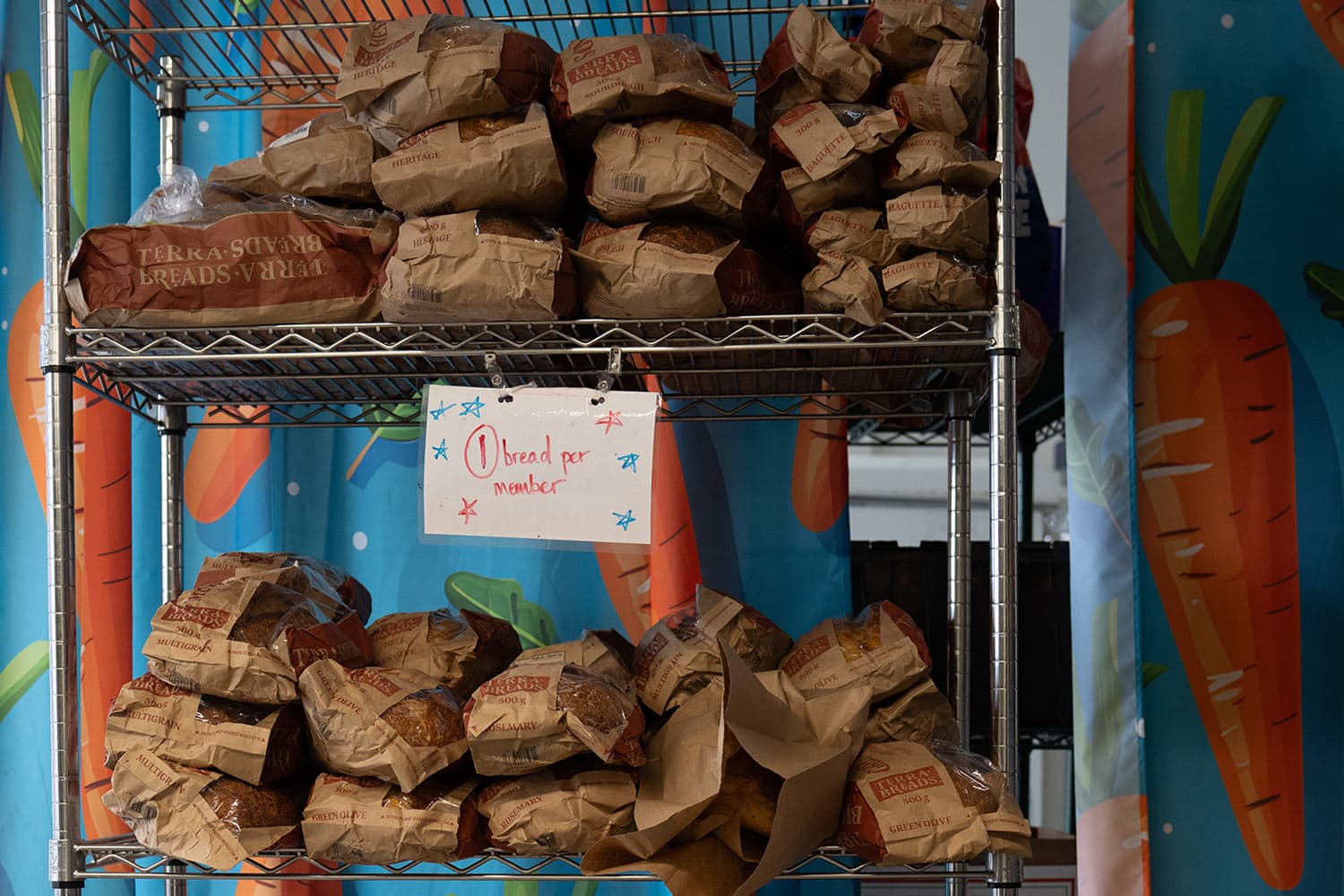
Rescued loaves are set out before members arrive at Food Stash Foundation’s weekly market in East Vancouver.
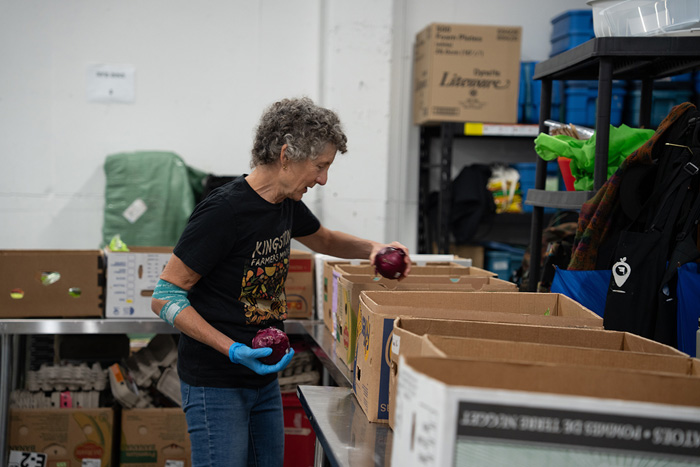
On a Thursday afternoon before the Rescued Food Market opens, the Food Stash Foundation’s East Vancouver warehouse doubles as a staging ground. Volunteers spend the hour packing boxes with whatever fruits and vegetables arrived that week—two onions here, peppers and zucchini there—while staff and volunteers arrange the market’s rescued groceries by category.
Food Stash picks up food from around 35 partners every month, including grocery stores, wholesalers, farms, and retailers. By redistributing edible “waste” food to people who need it, the nonprofit aims to ease food insecurity while keeping organic material out of landfills, thereby reducing greenhouse gas emissions. Its work also reveals the limits of food rescue: recovered groceries can provide immediate relief, but they cannot address the poverty underlying food insecurity.

Food Stash employs drivers who visit four or five grocery stores each morning to collect food that would otherwise be discarded, said Anna Gray, the organization’s communications specialist, in a Zoom interview. (Food Stash has built its partner relationships directly and through FoodMesh, a Vancouver-based company that connects surplus food with charities and farmers across Canada.) The drivers follow clear safety guidelines: they accept meat only if it was frozen by its best-before date, and reject anything mouldy or leaking.
Once collected, the food is sent in two initial directions. Most goes to more than 50 community partners across Vancouver, including groups running community meals, housing support programs, and other services. The remaining share returns to the warehouse, where some is packed into home-delivery boxes for 125 low-income households that include people with disabilities, while the rest stocks the Thursday market.
The market is open to members, who are chosen by lottery and pay C$36 for a three-month membership that allows them to “shop” for rescued food at no additional cost. (Disclosure: two people on the Asparagus Magazine team are currently members of the market.) By the time members arrive, the rescued food has been arranged throughout the space. There is a fridge stocked with items like yogurt, milk, and plant-based alternatives; freezers holding meat, fish, and other proteins; shelves full of bread; a table of assorted prepared food items; and a produce section where each member is offered one of the boxes packed earlier by the volunteers.
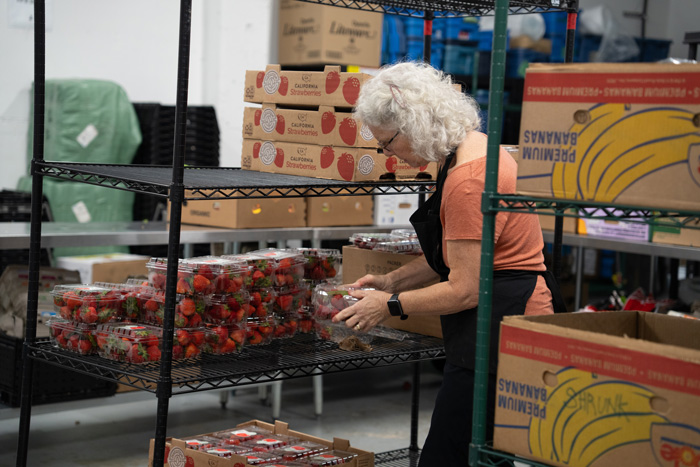
Food Stash focuses heavily on perishables, and sometimes that means C$17 blocks of cheese from Whole Foods moving through the warehouse alongside everything else. The average member takes home 9 to 11 kg of food at every visit, Food Stash Development Manager Stephanie Shulhan said on the day I visited the warehouse.
Every three months, about 370 people enter the lottery for 160 membership spots, according to Food Stash. Those selected receive appointment times throughout the market’s 3–7 p.m. window, so no one has to wait in line, said Stacey Hagerty, the market’s supervisor.
The market makes visible one of Food Stash’s central ideas: dignity. Here, that means having a choice of fresh, nutritious groceries without having to surrender unnecessary personal information. There is no ID check or lengthy registration process, Shulhan said, and the organization collects only the information it needs to run the program.“We feel this is an important part of dignified food access,” she said. Shulhan estimated that more than 90% of the market’s stock is perishable, nutrient-dense food that gives members the fresh-food choices Food Stash considers part of dignified food access.
Rescuing Food, Avoiding Emissions
Shulhan recalled a single dad, new to the market about a month earlier, who told her the space worked for him because it felt dignified and free of stigma. Shopping there also matched his environmental values. He liked that by choosing rescued groceries, he was playing a part in keeping good food out of the landfill.
When food and other organic waste decomposes in landfills, it releases methane, a powerful greenhouse gas. Canadian landfills accounted for 17% of the country’s methane emissions in 2023, according to Environment and Climate Change Canada.
Food Stash says calculations by GHG Accounting found that its work prevented a net 108 metric tonnes of carbon dioxide-equivalent emissions in 2025. That is roughly equivalent to the annual emissions of about 25 gasoline-powered passenger vehicles, according to the US Environmental Protection Agency’s Greenhouse Gas Equivalencies Calculator. Gray said that total accounted for the emissions created by Food Stash’s own operations, including warehouse refrigeration, heating and cooling, and having trucks on the road seven days a week.
In 2025, Food Stash’s work prevented annual emissions equivalent to about 25 gasoline-powered passenger vehicles.
“A lot of us came to Food Stash because we were drawn to the climate action piece and the food-based piece of it,” Gray said. “Then we get exposed to the community aspect, and that’s what keeps a lot of us staying here.”
On one recent Thursday, a newly retired volunteer was packing boxes on her first shift, years after she first dropped off egg cartons for the organization while riding her bike past its previous space. Food waste and food insecurity had bothered her for a long time, she said. “It just seems ridiculous in our country that there’s food going to waste” while people do not have enough to eat.
Nearby, a volunteer of more than four years described the boxing shifts as the most gratifying part: filling a box with food that would otherwise be headed to the landfill and knowing it is going to people who need it. Food Stash has also begun working with farmers and city residents who keep chickens, pigs, and rabbits to divert food that is no longer fit for people to animal feed instead of compost.
Gray was careful not to let the climate framing crowd out the rest of Food Stash’s mission. Asked what a transformed, sustainable, and just food system would require, she started with a future where there is less food waste to recover. In that version of the food system, fewer grocery stores, wholesalers, and farms would have surplus food for organizations like Food Stash to pick up.
That hope comes with a tension. If the waste Food Stash rescues were completely eliminated, the people and organizations it supports would still need food. Less waste and more access do not always point in the same direction. For Gray, the deeper issue is poverty.
“Food isn’t going to solve food insecurity,” she said. “It’s an issue of wages, of not enough social support for people.”
In 2025, nearly one in four people in Canada lived in a food-insecure household, including 2.4 million children, according to PROOF, a University of Toronto research program that analyzes Statistics Canada data. PROOF describes food insecurity as a problem of inadequate or insecure income rather than a shortage of food.
This is borne out by the answers members give on surveys about the market. Hagerty said the organization regularly sees responses like: “This allows me to pay for other things that I need to pay for in my life, rather than spending so much money on food.”
A Problem Food Cannot Solve
Food Stash is marking its tenth year of operation in 2026, a milestone Gray described as both a celebration and a prompt for reflection. The climate emergency, she said, feels more pressing to staff now than it did when the organization began.
At the same time, there seems to be growing recognition of food rescue as a response to both food waste and food insecurity. For instance, when pop star Taylor Swift and football player Travis Kelce celebrated their wedding by donating US$26 million to charities, they included US$1 million to City Harvest, which People Magazine described as New York City’s largest food rescue organization.
But most organizations like Food Stash still face the everyday challenge of funding the infrastructure required to keep food moving. Gray said the organization runs on a C$1.2 million annual budget that has to cover an unsubsidized warehouse, staff, trucks, gas, refrigeration, and other daily expenses. According to its 2025 annual report, the organization’s main sources of funding were individual donors, followed by foundations and corporate donations.
“We are stretched thin,” she said. “It can be hard to think big-picture when you’re very much in the day-to-day piece of it.
Food isn’t going to solve food insecurity. It’s an issue of wages, of not enough social support for people.
Those constraints make collaboration more important. Food Stash is a founding member of the Vancouver Food Recovery Network, which formally launched in December 2025 to coordinate surplus-food recovery and distribution across the region.
The eventual goal, Gray said, is for none of this to be necessary in the same way. No surplus food to intercept. No emergency food access filling gaps left by poverty. No market designed around dignity, because dignified food access would already be built into the food system.
Another volunteer, at the market weekly since spring 2025, put the aspiration plainly, “I would really like it if Food Stash didn’t have to exist.”
This story was first published on The Green House, our membership platform. Join us there for early access, discounts and freebies, community discussions, and to support our work telling the large and small stories of how we can live sustainably.