This Co-op Shows How to Make Older Homes Climate-Ready
Edmonton’s Sundance Housing Co-operative used an innovative model to retrofit aging homes without displacing residents.

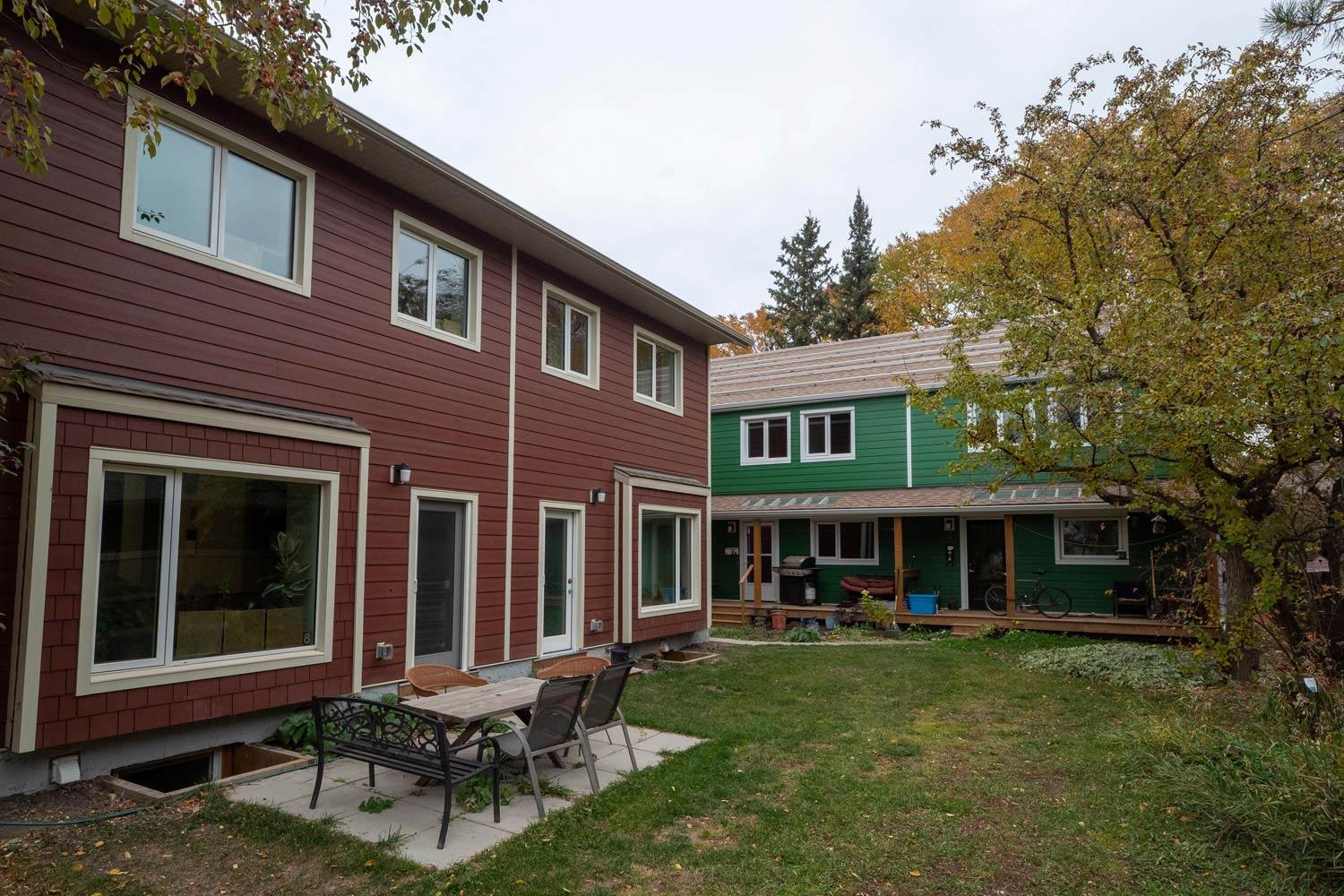
Sundance Housing Co-op townhouses after their Energiesprong-inspired retrofit was completed
Picture a row of aging townhouses settling in beneath a new layer of warmth. One by one, insulated panels were fitted against the buildings’ exterior walls. They covered the structures of Edmonton’s Sundance Housing Co-operative like pieces of a carefully measured quilt, meeting windows, doors, corners, and rooflines that had shaped the homes for decades. Inside, residents continued making dinner, answering emails, helping children with homework, and sleeping in familiar rooms as their homes were transformed around them. Today, solar panels above them turn Alberta sunlight into electricity.
Sundance began the multi-year retrofit in 2019 and completed it in 2024. The project was inspired by Energiesprong—Dutch for “energy leap”—a whole-house renovation model that originated in the Netherlands. The approach treats each home as a complete system, improving the building envelope, replacing fossil-fuel heating with efficient electric systems, and adding renewable energy where possible. Prefabricated exterior components can be manufactured off-site and installed from outside, limiting the need to open interior walls and allowing residents to remain home during construction.
“It combines something that we have to do for the climate with something that helps homes become more affordable, with something that’s just aesthetically pleasing,” said Maurya Braun, a principal consultant at climate-planning firm SSG, in a video call. “It feels like an upgrade.”

Braun described the process as “wrapping a house in a blanket.” The blanket is made from prefabricated panels filled with insulation. The panels resemble new sections of exterior wall. Built off-site, each one is shaped to fit a particular part of the building and accommodate its windows, doors, and corners. Fitted over an existing building, they create a continuous protective layer that reduces drafts and slows the movement of heat through the walls. Warmth stays inside longer during an Edmonton winter. During summer, the envelope helps moderate the effect of rising outdoor temperatures.
At Sundance, that blanket had to fit 59 townhouses spread across 15 buildings constructed in 1978. The co-op wanted to preserve homes that people were living in, make them more comfortable, and dramatically reduce the energy required to heat and power them. New windows, electric heat pumps for space heating, heat-pump water heaters replacing gas ones, heat-recovery ventilators, and solar panels completed the transformation.
With the Energiesprong approach, “life goes on for all of the residents,” Braun said. “A lot of what needs to happen is just popped onto the outside of the building.”

Typical townhouses at Sundance Housing Co-op prior to their deep energy retrofit
The efficiency upgrades reduced the buildings’ energy needs by approximately 70–80% and eliminated gas service to the 59 retrofitted units. Retrofit Canada classifies the development as “net-zero ready,” meaning its energy demand has been reduced enough that it could reach net-zero carbon emissions with additional on-site renewable power generation. The co-op’s rooftop solar arrays were originally projected to supply about 75% of its reduced annual energy needs. A case study from the Green Municipal Fund now puts that figure at 78% following the installation of the panels in summer 2025. Reaching full net-zero emissions would require more solar panels; in the meantime, the co-op purchases renewable electricity from Foothills Energy Co-op to cover the balance.
Sundance was also designed as a national demonstration project. Natural Resources Canada contributed approximately C$2.75 million toward the project’s total cost of C$5.69 million to test whether the Energiesprong approach could work across an entire Canadian residential complex and be replicated elsewhere. Before the project was completed, the department projected that the planned rooftop solar system would bring the net-energy-use reduction to 94%, alongside an 84% reduction in greenhouse-gas emissions.
The department describes the Sundance retrofit as Canada’s first use of the Energiesprong approach across an entire residential complex. The project shows how applying Energiesprong could reduce Canada’s greenhouse-gas emissions and lower household energy costs. It also shows the challenges building owners may face in adopting the model.
The scale of the retrofit challenge
For Peter Amerongen, who led Sundance’s retrofit for Butterwick Projects Ltd., years of planning left one anxious question hanging over the project: Would all the pieces fit?
“When the panels fit, that was really fun,” Amerongen said in a video call. “We had 350 panels, all slightly different from each other, and every single one fit.”
Buildings have a major influence on Canada’s greenhouse-gas emissions. According to the federal Canada Green Buildings Strategy, they produced approximately 89 million metric tonnes of greenhouse-gas emissions in 2022, accounting for 13% of Canada’s total emissions. Most direct building emissions come from fossil fuels used for space and water heating. When emissions from generating the electricity used in buildings are included, the sector’s share rises to 18%.
About 70% of Canada’s existing residential dwellings need improvements to reduce greenhouse-gas emissions, according to the aforementioned federal strategy. Overall, the government estimates that approximately 11 million buildings will need to be retrofitted in the coming decades as Canada works toward achieving net-zero emissions by 2050.
It combines something that we have to do for the climate with something that helps homes become more affordable.
That need will only grow in importance as climate change follows people indoors. The BC Coroners Service attributed 619 deaths to the heat dome that settled over the province between June 25 and July 1, 2021. Research following the 2021 disaster found that low-income people without air conditioning were at particularly high risk.
Extreme heat has recurred across Canada in the years since. In summer 2026, parts of Eastern Canada were placed under heat warnings as temperatures climbed into the mid-30s. In Quebec, July 2026 was the third-hottest July recorded since 1921, with two heat waves affecting the first half of the month. A building envelope designed for future climate conditions can help moderate changes in outdoor temperature. Summer safety also depends on shading, ventilation, and efficient cooling.
The cost of going first
Sundance shows what a comprehensive retrofit can accomplish. It also reveals the investment and risk involved.
Cost is the largest obstacle to scaling deep retrofits, Amerongen said. Sundance succeeded partly because participants accepted risks “that no sane business would typically take.” The co-op was already facing substantial upgrades to its aging buildings. Its members chose a deep retrofit over more limited repairs, seeing an opportunity to extend the life of their homes while advancing the co-op’s affordability, sustainability, and climate goals. The federally funded project was also designed to demonstrate an approach that could be replicated elsewhere. Much of its development preceded the increases in construction costs that followed the Covid-19 pandemic.
The Energiesprong model seeks to reduce costs through industrialization. Producing components in factories for many similar buildings could make manufacturing faster and cheaper, while spreading fixed costs across more projects. Canada has yet to generate the steady demand required to achieve those savings. High prices, in turn, discourage building owners from commissioning more projects.
Buildings also vary widely. Foundations, rooflines, windows, doors, and wall projections require different responses. Designers must determine which elements can be completed in a factory and which require work on site. Each exterior layer must also safely control rain, moisture, and water vapour.

Assembled wall panels awaiting installation at Sundance
Whole-building deep retrofits such as Sundance’s require extensive coordination and investment. Owners may need to work with energy modellers, architects, engineers, manufacturers, contractors, utilities, lenders, and several levels of government.
“We need to do it a number of times and learn how to do it before we try to scale it,” Amerongen said.
That need contributed to Amerongen co-founding Retrofit Canada. Its online library currently contains 51 case studies, documenting projects’ designs, costs, successes, and challenges so that others can learn from what has already been tried.
“It’s a long haul,” Amerongen said. “It’s a very complex thing.”
Who pays and who benefits?
SSG’s Braun sees townhouses and low-rise apartment buildings as promising candidates for Energiesprong-style retrofits. Their relatively simple structures can make large exterior panels easier to install.
The potential savings could be particularly important for lower-income households, which can spend a larger share of their income on energy. Statistics Canada classifies households as “energy poor” when they spend at least 10% of their after-tax income on dwelling energy. The agency’s analysis of the 2021 census found that 9.7% of households in homes requiring major repairs experienced energy poverty, almost twice the national rate of 5.6%. By comparison, the rate was 5.3% among households whose homes needed only regular maintenance or minor repairs. In other words, many people living in homes that require the most work have limited ability to finance it.
In the case of rental housing, the costs and benefits are divided between different parties. Building owners pay for improvements; tenants may receive some savings through lower utility bills. Natural Resources Canada describes this arrangement as a “split incentive.” However, tenants can face additional costs when renovation expenses result in higher rents. In BC, a landlord can apply to the Residential Tenancy Branch for permission to recover certain capital expenses through rent increases above the ordinary annual limit. Eligible work can include improvements that reduce energy use or greenhouse-gas emissions. For tenants, lower energy bills do not necessarily mean lower overall housing costs.
They should be able to remain in their homes, experience lower combined costs, and influence decisions.
Under the province’s Residential Tenancy Regulation, approved expenses are divided among the affected units and spread over ten years. For example, if a landlord were approved to recover $7,200 for one unit, the calculation would produce an additional rent increase of $60 a month. For a tenant paying about $1,000 in monthly rent, however, the landlord could impose only about $30 in the first phase because each phase is capped at 3%. The remaining amount could be added in a second phase the following year, alongside the regular annual rent increase.
If the rent increase used to pay for a retrofit is greater than the resulting savings on utilities, a tenant can end up paying more each month even though their home uses less energy.
A retrofit’s success should therefore be measured through its effects on residents. They should be able to remain in their homes, experience lower combined costs, and influence decisions about the work being done.
When asked how residents could hold real decision-making power over changes to their homes, Braun said the process would have to reflect each community’s priorities. “You would have to meet with different communities and get them involved in the decision-making process in the way that they would want to be involved,” she said. “Different communities want different things.”
From pilot project to national policy
Braun believes retrofit funding should be easier to navigate. She described a system in which building owners could submit one application in order to receive support from federal, provincial, and other programs, instead of applying to each fund separately.
Federal support has begun to target the kind of whole-building retrofits tested at Sundance. First funded in the 2022–23 fiscal year, the C$35.5-million Greener Neighbourhoods Pilot Program opened its demonstration-project call in June 2023 and closed it that September. The program is supporting Energiesprong-style deep retrofits in clusters of low-rise community housing, building on earlier federally funded projects such as Sundance.
The application stage has ended, and NRCan lists demonstration projects in St. John’s and Hamilton as active. The retrofits must be completed by March 31, 2028. Each demonstration must include at least 100 homes or housing units and target reductions of at least 50% in annual energy use and 80% in greenhouse-gas emissions.
This would make an absolutely amazing nation-building project.
For individual households, the C$800-million Canada Greener Homes Affordability Program provides no-cost energy-efficiency upgrades to eligible low- and median-income households, including renters. Participating provinces, utilities, and energy-efficiency agencies assess homes, arrange contractors, and cover the approved costs, so participants do not have to finance the renovations themselves.
Braun also wants Canada to finance deep retrofits as national infrastructure, reflecting their social, economic, and environmental benefits.
“I have been thinking that this would make an absolutely amazing nation-building project,” she said, referring to Prime Minister Mark Carney’s economic agenda, which uses the term “nation-building project” for major infrastructure intended to strengthen Canada’s economy, resilience, and security.
In the model Braun imagines, governments would provide upfront capital. Repayments could be structured so that residents save more on their energy bills than they pay toward the retrofit, lowering their total monthly housing costs from the start. Public investment would support workforce development, while a predictable stream of projects would give manufacturers confidence to expand.
“If we care about the people in our country, we should make their homes livable and beautiful,” Braun said. “We should skill up people so that they can keep doing that work.”
This story was first published on The Green House, our membership platform. Join us there for early access, discounts and freebies, community discussions, and to support our work telling the large and small stories of how we can live sustainably.