Turkey is Destroying Ecosystems in Iraqi Kurdistan
Activists and researchers want more eyes on the little-reported destruction some call ecocide.
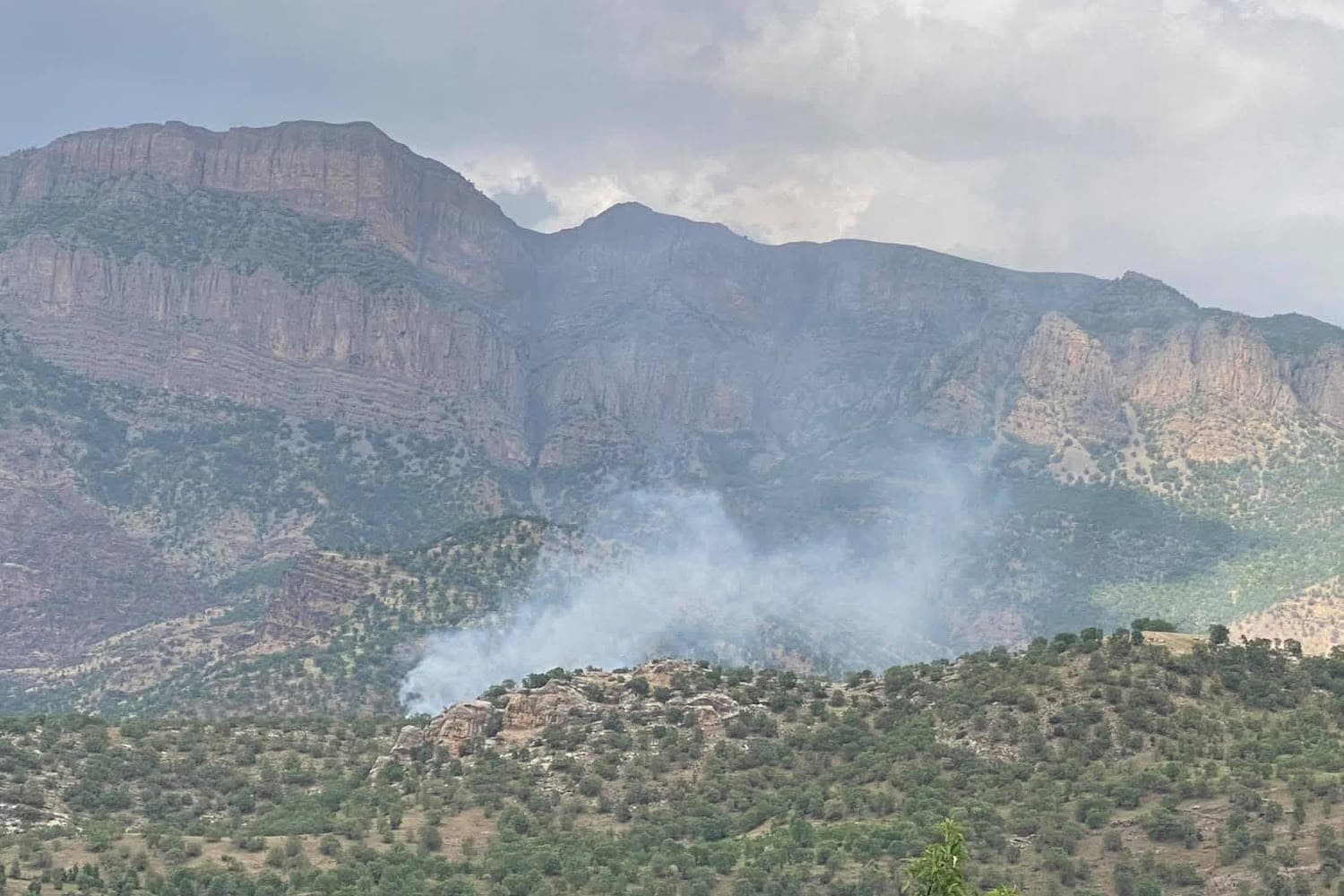
Following a Turkish bombardment in 2021, smoke rises about 10 km from the Turkish-Iraqi border in front of Kista Mountain in Duhok Governorate, Kurdistan Region, Iraq.
Ali Dawtiy wants to eat fresh tomatoes from his village. Chê—referred to online as “Gunde Chê” (gunde means “village” in Kurdish)—is in the Upper Doski region of Duhok province in Iraqi Kurdistan and was forcibly evacuated by Turkish forces in the 1990s. For generations, Dawtiy and other area residents would go to nearby Chiya Spi (“White Mountain”) in spring to gather wild greens, bringing home the season’s first tastes from the land, including rhubarb, tumble thistle, and wild liquorice, fennel, and onion.
But since last year, villagers are no longer allowed to return even for this harvest, as the area has become part of what locals call “the forbidden zone.” They can only look from a distance toward the mountains they once walked freely, knowing that many of the plants and trees that defined those landscapes are gone.
“The Turkish army controlled our villages, [let a company] cut down trees, and built military bases, preventing us from returning,” Dawtiy, a high school history teacher, told Asparagus in a phone interview in Kurdish. According to Dawtiy, Chê is among 110 villages in the Upper Doski district that Turkish forces have evacuated since the early 1990s. In June, residents of villages near Zakho—about 100 km west along the Turkish border—were allowed to visit their communities under strict conditions. But many, including Chê’s villagers, are still forbidden access.

In 2023, Milko Baziani, the chairman of the Kurdistan Green Party, told Kurdish outlet ROJ News that the majority of the trees have been cut down by Cengiz Holding, a Turkish energy and mining conglomerate. The Greens allege that the company has cut down more than 3 million trees since 2018, which include oaks, hawthorns, wild pears, and wild pistachios.
Dawtiy explained that the cut-down trees are transported to Turkey, where they are made into furniture and other products. He says Turkey treats the region as part of its own territory rather than another country. “This is a humiliation of our country and a violation of our natural heritage,” he said.
Kamaran Osman is an on-the-ground investigator with Community Peacemaker Teams–Iraqi Kurdistan (CPT-IK). CPT is an international NGO that documents human rights and environmental issues in conflict-affected regions. Osman’s team of three or so staff members plus volunteers is based in Slemani, about 300 km from Chê in southeastern Kurdistan.
In a phone interview in Kurdish, Osman told Asparagus that the Turkish military has established 139 bases and outposts in Iraqi Kurdistan. He says that since the 1990s, 1,192 villages across the region have experienced impacts like the destruction of houses, schools, and health centres, and the burning of gardens and farms. Of these villages, 590 have been completely evacuated, with 185 remaining forbidden even to officials from the Kurdistan Regional Government (KRG) and the Iraqi national government. Ongoing bombardment has forced the partial evacuation of another 602 villages.
Turkey’s actions are not merely causing environmental damage; this sustained policy of ecological harm mirrors decades of oppression experienced by Kurds, making the ongoing crisis both a human and environmental tragedy. “Turkey is committing an ecocide,” Osman said.
What is “ecocide”?
An early use of the term “ecocide” was by American biologist Arthur Galston at the 1970 Conference on War and National Responsibility in Washington, DC, when he proposed an international agreement to ban the mass destruction of nature. He used the word to describe the widespread deforestation caused by Agent Orange during the Vietnam War. Over the following decades, environmental scholars and advocates kept the idea alive through discussions at international forums and conferences.
However, by the 1990s, the concept had lost momentum in international legal discussions. Ecocide lacked a formal legal definition and received little recognition in mainstream legal discourse. British barrister Polly Higgins revived the concept in the 2000s, campaigning internationally for ecocide to be recognized as a crime under international law and helping bring it back into legal and political debate
In 2020, the Stop Ecocide Foundation brought together an expert panel that proposed ecocide as a possible fifth crime under the Rome Statute of the International Criminal Court—alongside genocide, crimes against humanity, war crimes, and the crime of aggression. The panel developed a legal definition: “unlawful or wanton acts committed with knowledge that there is a substantial likelihood of severe and either widespread or long-term damage to the environment being caused by those acts.”
How did the destruction begin?
Turkey has justified its presence in Iraqi Kurdistan by citing its fight against the Kurdistan Workers’ Party, the Kurdish nationalist organization most commonly known as the PKK. The conflict began in the 1980s and has killed more than 40,000 people, including Turkish forces, PKK rebels, and civilians.
The Kurdish people are an ethnic group in West Asia who speak a group of languages in the same family as Farsi and Pashto. An estimated 30–45 million Kurds live across the Middle East, mainly in Turkey, Iraq, Iran, and Syria. Kurds make up about a quarter of the population in both Turkey and Iraq. There has never been a Kurdish-majority state, and, despite these large numbers, Kurds have often been denied basic rights.
A movement for Kurdish independence began in Iraq in the 1960s, led by the Kurdish Democratic Party. In 1970, Iraq’s ruling Ba’ath Party and Kurdish leadership signed a peace agreement that would give Iraqi Kurds self-rule in a Kurdistan Autonomous Region. However, the law the Iraqi government put in place in 1974 to implement the agreement did not live up to Kurdish expectations, leading to a resumption of the revolt by Kurdish Peshmerga fighters.
Saddam Hussein became president of Iraq in 1979 and, that same year, endeavoured to crush the Kurdish liberation movement by forcing at least 4,000 villages across Iraqi Kurdistan to evacuate, relocating their residents to government-controlled collective towns. In 1988, Hussein ordered further destruction of Kurdish villages and towns in an effort to eliminate the Peshmerga—a genocide known as the Anfal campaign. In March 1991, Iraqi Kurds rose up against Hussein’s regime, and the Peshmerga took control of most Kurdish cities and towns in northern Iraq.
This systematic destruction severs a centuries-old harmony with nature and threatens the cultural fabric of the Kurdish people.
Across the border, Turkish governments since the 1923 founding of the modern Turkish Republic have denied the existence of Kurds and banned Kurdish language, culture, and political expression. The PKK emerged in Turkey shaped by decades of repression and forced assimilation. The organization was founded in 1978 by Abdullah Öcalan, who subsequently fled to Syria and has been imprisoned by Turkey since 1999.
The PKK launched an armed uprising in Turkey in 1984, seeking greater Kurdish rights and autonomy. Since then, Turkey has carried out repeated military operations inside Turkish Kurdistan and, according to Kurdish MP Ali Hama Salih, has advanced about 50 km into Iraqi Kurdistan, where PKK fighters have established bases. Despite periods of ceasefire and peace talks, the conflict continues to destabilize the region.
After the 1991 uprising in Iraq, the Kurdistan Regional Government was established, and a UN-backed no-fly zone prevented Hussein’s regime from reoccupying it. Many families were able to return home, but Turkish military operations and the ongoing conflict with the PKK prevented residents of some villages along the border from returning.
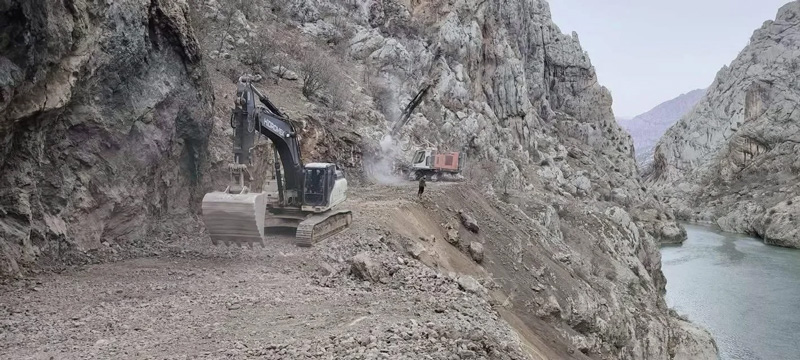
According to CPT-IK, the Turkish military began constructing new roads to connect military bases in Amedi District in February 2026.
Turkey’s large-scale deforestation and construction of military infrastructure may reflect a neo-Ottoman agenda, using territorial control to project influence in former Ottoman lands and limit Kurdish aspirations for autonomy. These operations damage forests, farmland, and water sources in the region. Some village residents in Duhok say the environmental and human impacts of these military operations evoke memories of the genocidal Anfal campaign.
In February 2025, PKK leader Öcalan wrote a letter from prison calling on his party to disarm and dissolve, and the PKK announced a ceasefire soon after. Turkish President Recep Tayyip Erdoğan welcomed this change as a historic opportunity to end the decades-long conflict. Dawtiy and other displaced Kurds were thrilled by the peace process and the prospect of visiting their villages, and many farmers hoped to return to their normal lives after years of oppression by both the Turkish military and the former Iraqi government.
However, Turkey has continued its military operations in both Turkish and Iraqi Kurdistan, raising questions about its commitment to peace. The dream of return has nearly faded, and the fragile peace process may go nowhere, as Turkey continues to militarize Kurdish areas and carry out deforestation.
Turkey’s ongoing campaign
Osman, the CPT-IK investigator, said the “Turkish ecocide” started in the 1980s, when conflict between Turkey and the PKK extended into Iraqi Kurdish regions. The Turkish military would set fire to forests or cut down trees where they believed PKK guerrillas were based. Osman says that from 1991 to 2017, the destruction intensified as part of a strategy to establish a buffer zone between Turkey and the area where the PKK existed.
Between 2017 and 2024, the Turkish military burned an estimated 180,000 hectares of farmland while targeting PKK positions, according to CPT-IK. Osman said that in 2025 “the Turkish army took control of 11 mountain ridges and exploited caves, including five large ones.” He added that significant locations—including archeological sites and houses of worship—have been “damaged or destroyed.”
Turkey largely ignores the catastrophic environmental and climatic consequences.
Osman has repeatedly visited affected areas, speaking with residents and collecting data about destroyed and evacuated villages, burned farmland and orchards, damaged homes, and blocked access to agricultural land. He also gathers firsthand accounts of environmental destruction. He described a pattern of sustained damage to both livelihoods and ecosystems across the region.
Based on data he has collected, Osman says large-scale tree cutting and timber transfer took place in multiple phases, notably in 2021 and again in 2024. In 2021, approximately 450 metric tonnes of timber were cut and transported to Turkey daily over a period of 45 to 50 days. He added that in 2024, around 95 truckloads of timber were transferred into Turkey over a period of roughly 24 days.
On February 6 of this year, CPT-IK reported that Turkish forces resumed military activity in Iraqi Kurdistan, planting explosives along mountain ridges to build roads in an already severely deforested area. The blasts marked a turning point after months of calm during the peace process. Osman says that since then, the activity has not stopped. Over the past six months, Turkish forces have expanded their road networks and military presence in the Amedi district of Duhok Governorate, continuing to destroy forests and reshape the landscape.
Explanations questioned
For locals like Dawtiy, Turkey’s justifications for this destruction ring hollow. “We know Turkey says it is here to fight the PKK, but the group does not exist in our area,” says the teacher. “What we see instead is a plan to occupy Kurdistan, as it has done in Syrian Kurdistan, invading Afrin and other Kurdish towns.”
Khaled Sulaiman is an independent environmental researcher from Iraqi Kurdistan, who writes about climate for several regional and international publications. He agrees with Dawtiy. “These are actually flimsy arguments and are not based on reality, because the region is essentially under the control of the Turkish army,” Sulaiman wrote in an email. “By destroying the local ecosystem—down to the microbiological health of the soil—these operations force local populations to abandon ancestral lifestyles centred on agriculture and herding. This systematic destruction severs a centuries-old harmony with nature and threatens the cultural fabric of the Kurdish people.”
Sulaiman said the Turkish army’s deforestation operations echo past conflicts where ecosystems were treated as collateral damage. “Under the guise of security, the Turkish state has stripped the mountains of their natural vegetation,” he explained. “Because these operations occur outside its borders, Turkey largely ignores the catastrophic environmental and climatic consequences.”
“The strategy is also driven by economic gain,” he continued. “Tonnes of timber are taken daily at no cost and transported to Turkish markets.” These operations extend beyond Iraq, with Turkish-backed groups also logging in Kurdish areas of Turkey and Syria. The widespread logging reinforces Sulaiman’s and Dawtiy’s claims that the destruction isn’t just about Turkey’s stated security objectives.
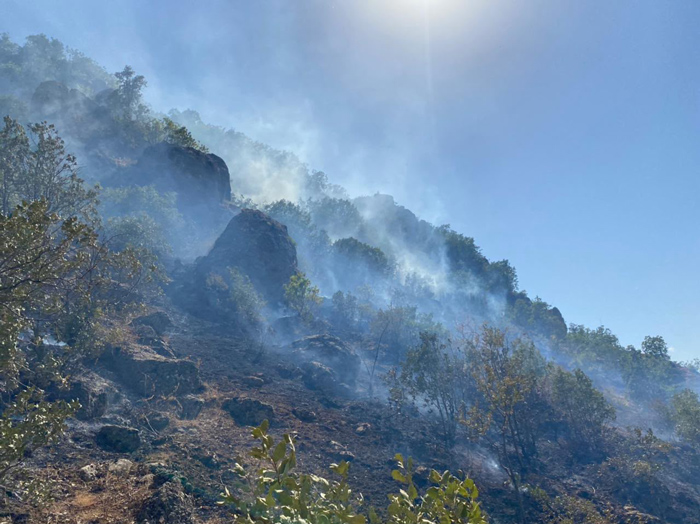
A hillside near Hirure, Duhok Governorate, burns following a Turkish bombardment in 2021.
Dr. Lina Eklund is an associate senior lecturer in the Department of Earth and Environmental Sciences at Lund University, Sweden, who specializes in the Middle East and has conducted field studies in Amedi, Dawtiy’s home district. She uses satellite remote sensing and Geographic Information Systems (GIS) to document conflict-related ecological changes, deforestation, damage to agricultural land, and the loss of vegetation cover linked to Turkish military operations.
In a Zoom interview with Asparagus, she noted that though ecocide is still not a crime under international law, some international and national laws do address environmental harms—like pollution that forces displacement or attacks causing long-term damage to nature—but they remain unenforced. “No such cases have, however, been prosecuted in the International Criminal Court,” Eklund said, highlighting a gap between law and accountability.
Proving intent in conflict zones is particularly difficult because access is limited and evidence is hard to collect. “What we can do is document as much as possible to ensure accountability later,” she said, emphasizing that documentation alone does not prevent ongoing harm.
Eklund also noted that vegetation fires in Iraqi Kurdistan have often occurred in areas and periods associated with Turkey–PKK clashes, particularly around Amedi. Although the full impacts of these fires haven’t yet been studied in detail, she explained that “the consequences of forest fires are well understood: they can damage biodiversity, pollute air and water, and affect the health and livelihoods of nearby communities.”
What can be done?
As the destruction continues and accountability remains limited, the question is what can be done, locally and internationally, to stop it. Edhem Barzani, a Kurdish politician, has argued that Kurdish political parties must unite against the Turkish occupation. Meanwhile, the Kurdistan Democratic Communities Union, a political umbrella group that includes the PKK, has criticized the ruling Kurdistan Democratic Party and Iraqi government, saying they “refuse to acknowledge what is at stake.”
Researcher Sulaiman criticized both governments for not taking a more active stance. “To date, the response from both the Federal Government in Baghdad and the KRG has been notably insufficient, consisting only of a singular joint statement from their respective ministries of agriculture,” he said.
The Kurdistan Regional Government made a statement in 2020 calling on Turkey “to respect the sovereignty of our homeland,” and the Iraqi government has brought Turkey’s attacks in the region to the attention of the UN security council multiple times since 2018. In 2022 this resulted in a UN representative condemning an attack on a resort in Iraqi Kurdistan that Iraq attributed to Turkey, but the condemnation did not assign blame. More concrete steps have not been taken.
For Osman, documenting the destruction through written reports is one of the few tools available to bring about change. He says his team continues to collect evidence and share findings with NGOs, UN agencies, and foreign consulates in an effort to raise awareness and push for accountability. In the absence of political action, he emphasizes that civilian organizations are often the only link between affected communities and the outside world: “We try to reach anyone who can listen.”
For his part, Dawtiy still hopes to return to his village. “Many people from my village, Chê, and other villages hope to see our homes rebuilt, the Turkish military withdraw from the region, and the environment protected,” he wrote in a follow-up note after our interview. “We want to rebuild our lives, and continue growing the fruits and vegetables that have connected us to our homeland for generations.”
This story was first published on The Green House, our membership platform. Join us there for early access, discounts and freebies, community discussions, and to support our work telling the large and small stories of how we can live sustainably.