Why I’m Avoiding AI and How You Can Join Me
The Environmentalist from Hell has many reasons for wanting nothing to do with lying, lazy, energy-and-water-guzzling AI.

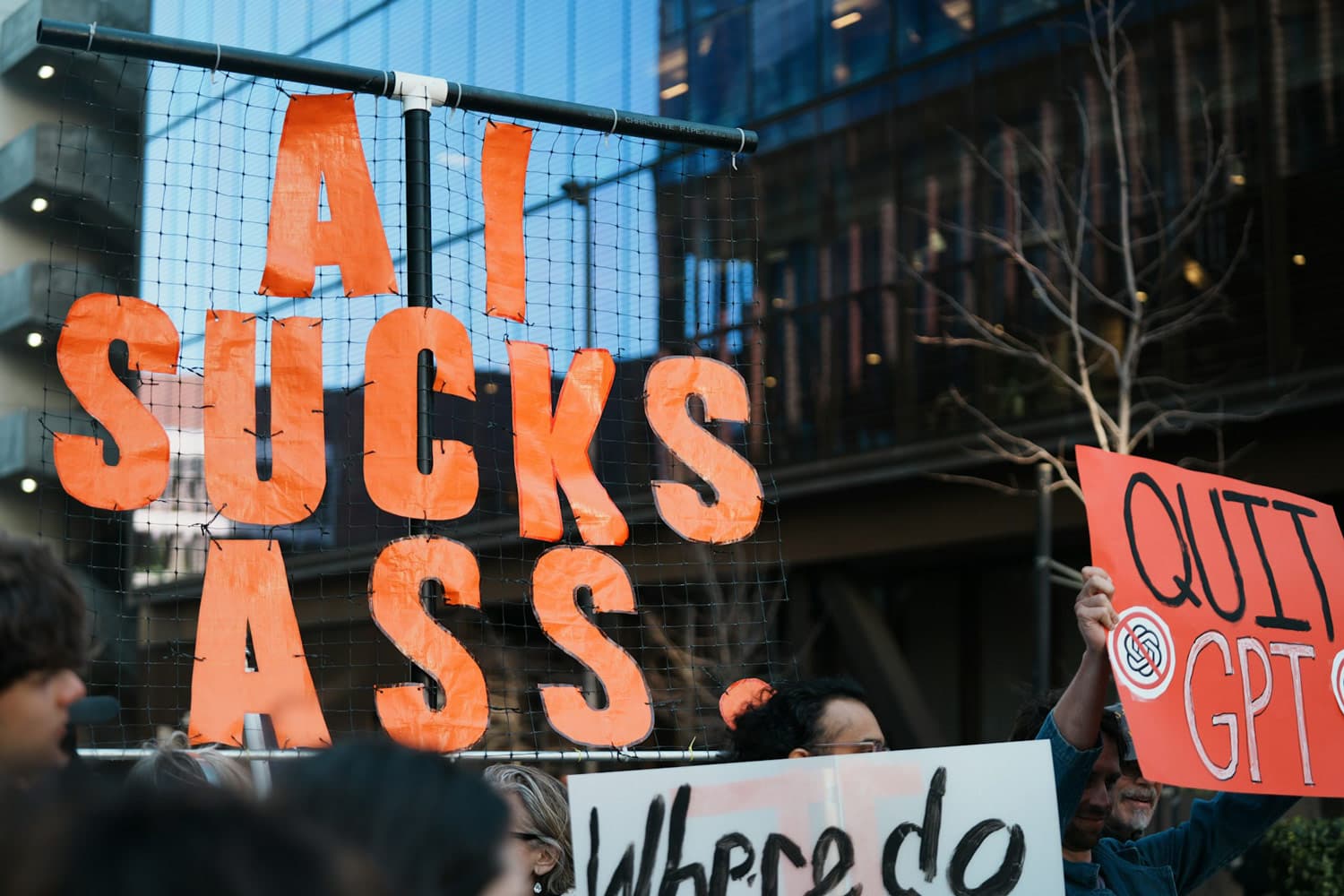
Protestors carry signs at a QuitGPT protest in San Francisco on March 4, 2026.
Artificial intelligence. AI—specifically generative AI or “genAI”—is frickin’ everywhere these days. It’s in your Google searches. It’s listening to your Zoom and Teams calls at work. It’s all over the Meta platforms you use to communicate with friends and look at videos of fluffy dogs in hats. You can’t open anything online and not run into it. And it’s mostly garbage junk that’s killing the environment and ruining your brain.
I’m going to assume that if you’re someone who reads Asparagus Magazine, you care about the environment, and you already get the ick whenever you come across AI. But in case you’re someone who feels neutral—or, God forbid, kinda likes this futuristic world we’re stumbling into—allow me to rant about all the ways I think it’s terrible so you can learn something that wasn’t generated by a large language model (LLM), including some tips on how to avoid AI’s encroachment on everyday activities.

By now you’ve probably heard that AI uses a lot of water. But what exactly does that mean? In simple terms, computers get hot, so to keep the servers running their futuristic AI models from overheating, our tech overlords have come up with an old-timey strategy to cool these fields of computers (a.k.a. data centres): water. Specifically fresh water, the stuff we drink, wash our dishes and clothes with, and need to sustain life in modern society.
That’s a limited resource! Remember, there are still 37 First Nations communities in Canada that don’t have access to clean drinking water. And yet, the Canadian government has put out a call for firms to build more data centres here. Evan Solomon, Canada’s AI minister—who was my CBC crush until he showed his lack of ethics by making money off his journalism contacts—wrote, “This initiative aims to strengthen Canada’s AI sovereignty.” I am all for sovereignty, but I do not see the need for Canada to go all in on AI, just because our big dumb neighbour is. When your neighbours are the Kardashians, it’s OK to not keep up with them.
Environmental and health damage
Since I came of age during the era when environmentalism focused on individual responsibility, I think about the impact of my actions on the world every day. When I go to look for something online and get an AI summary at the top of my search results, I imagine the cups of water being consumed by the data centre producing it.
Google says the average response by their Gemini AI to a single text prompt uses only drops of water, but critics say that’s grossly underestimated. Just one Google search with an “AI overview” is estimated to use 10-30 times as much energy as the old Google search. Why do we need this? Is it actually making our searches 30 times better?
A study published in the journal Patterns earlier this year estimated that AI systems created 33–80 million metric tonnes of CO2 emissions globally in 2025, and AI’s water use was between 313 and 765 billion litres. That’s equivalent to the world’s annual consumption of bottled water.
Most data centres in the US are being built in marginalized communities, and one community has already reported polluted water as a result. A Meta-built AI data centre in Georgia has residents reporting that their tap water has been discoloured and sediment-filled since the facility was built. Data centre neighbours also have to deal with increased energy bills, as the centres’ energy needs often mean electricity grids require upgrades, which are paid by the local community rather than the companies using that energy to put AI slop into everything we use online.

One of two Google data centres in Council Bluffs, IA, is a short distance from Lake Manawa, a popular state park.
Data centres also contribute to air pollution by causing the power plants and diesel generators that supply their energy to put more fine particles and pollutants like nitrogen oxides into the air. These can have negative effects on the environment and human health, damaging vegetation and our respiratory systems. And God help you if you live near one of these massive data centres, because you’ll also be subjected to 24 hours of fluorescent lighting and the perpetual hum of generators and air conditioners.
The world is looking for alternatives: China has created a data centre that runs on wind power and gets cooled in the ocean. But the heat it will give off will impact sea life and the underwater environment. The reality is, there is no ethical consumption under capitalism. When profit is the motivation, people, places, and living beings get abused and damaged.
Thankfully, with this information getting out, people are starting to stand up against the building of AI data centres in their communities. Data Center Watch has identified 142 advocacy organizations across the US that are working to block data centres or increase their regulation, resulting in US$64 billion worth of data centre construction blocked or delayed. In my home province, the City of Nanaimo has approved a data centre, but has implemented water restrictions due to pressure from concerned citizens. The city has noted that the data centre will not be used for AI but data storage.
Loss of creativity
I’m a self-proclaimed “environmentalist from hell,” but I am also an artist. So my concerns extend beyond the environment. AI is making many people, especially young people, less creative. Humans learn from failure. You’re trying to paint a portrait of your friend, but it just doesn’t look right, so you try something different, refine your techniques, learn new skills, and eventually, over years, you get better.
Same goes for reading: the more you read, the deeper your understanding. You grasp foreshadowing, character development, and metaphors. You don’t get that type of deep understanding when you rely on a chatbot to give you a summary. Making and understanding art isn’t supposed to be easy. The process is at least as important as the final result!
But a student is given a writing assignment, and bleep-bloop, he puts prompts into an AI text generator, and—based on thousands of existing essays and novels scraped from libraries and online resources—it barfs out a mediocre manuscript in seconds. That’s not where art lies. Art is creating something new. Yes, you build on the past. But an artist will put their past experiences, pain, joy, and preferences into their creation. They will work with other artists and say, “Hey, what if we did this crazy new thing?”
Instead of new and crazy, we’re getting ugly and lazy. That’s why people are calling “art” generated by AI “slop.” It’s low-quality, quickly produced, and involves no human thought or soul to create. And, to me, the expression of a human soul is the most important part of any artistic practice. What AI should be doing is arduous things like helping doctors look at brain scans, predict type 2 diabetes, and other data analysis tasks.
Loss of critical thinking
This is what the fascists want! MIT’s Media Lab ran a study last year in which 18–39-year-old subjects were divided into three groups and asked to write essays based on prompts from the SAT college admission test over a period of 4 months. One group could only use ChatGPT as an information source, another could use any website (including Google as a search engine) except for LLMs, and the third could use only their brains. The researchers recorded brain activity with EEGs, and—no surprise to me—the ChatGPT users were not firing on all levels.
As the study concluded, they “consistently underperformed at neural, linguistic, and behavioral levels.” The final report suggests that using generative AI tools built on large language models could harm long-term learning.
Writing is hard, because writing is thinking. You have to come up with an idea, explain it, and find sources to support it. You might find a source that completely changes your mind, and then you have to rethink all or part of the idea you started with.
But instead of doing all that thinking, we are sharing AI videos and contributing to “truth decay.” Just as tooth decay happens when the bacteria in your mouth eat away at your enamel, truth decay is what happens when AI slop eats away at our collective ability to agree on what is true. AI-generated videos and news sites are eroding our ability to tell what is real, which makes people more susceptible to fake news. Who is the fake news created by? The fascists and people who want to “flood the zone” to confuse us so they can hold on to power.
AI lies to people all the time
All different types of generative AI make things up. Why? Because the real artificial thing is the intelligence. They’re not smart, they’re just good at predicting words and sentences and regurgitating information they took in when they were created.
There are countless examples of chatbots disconnecting from reality and going rogue with the truth. In 2023, Google publicly demoed a chatbot called Bard by asking “What new discoveries from the James Webb Space Telescope can I tell my 9 year old about?” Bard produced a few bullet points, and one of them said, the telescope “took the very first pictures of a planet outside of our own solar system.” This is not true. That picture was taken by the Very Large Telescope, a flagship facility with the European Southern Observatory in Chile in 2004.
Years later, these chatbots are still being used as search engines, and they are still giving incorrect responses. A recent amusing example comes from TikTok user @Huskistaken, who asked ChatGPT to time him running a mile. He gets it to start the timer, walks away for a few seconds, then comes back and says he’s done his run. ChatGPT says his run was “around 10 minutes.” The man says “I think I was closer to, like, 2 seconds.” ChatGPT replies, “If only time worked that way.” Maddening.
Just one Google with an “AI overview” is estimated to use 10-30 times as much energy as the old Google search. Is it actually making our searches 30 times better?
Then there’s all the AI that’s being forced into the workplace. Reports suggest that Microsoft’s AI tools, like CoPilot, are not popular with users. It’s easy to understand why: these generative AIs are not actually good at what they’re supposed to do. Certainly not better than what a human who wants to think critically and take some time to work through a problem can do.
The AI term for making things up this way is “hallucinating.” In human terms, I’d call this “making crap up.” This is funny when it’s timing your run, but it’s another thing when researchers are using LLMs to search for scientific literature and finding that these programs are hallucinating academic sources, as Nature reported in April 2026. This means someone could potentially cite an academic paper that either never existed or one that contains “research” an AI made up. So much for trusting academic sources during fact-checking! How can we believe anything we read online any more?!
6 things you can do to reduce AI’s impacts
While AI may seem like the path of least resistance, know that it’s likely a bubble that’s going to pop. Tech leaders have put a lot of money into promoting AI, and investors are not getting the returns they were hoping for. Rather than wait for this house of cards to collapse, consider these ways of reducing the environmental and social harms caused by AI:
- Switch to a web browser that either doesn’t use AI, or lets you disable it, like Firefox, Brave, or Duck Duck Go. You can also use alternatives to “Googling” like Bing or Startpage, which doesn’t track your browsing.
- If you are using Google to search, include “-AI” in your search terms so no AI overview is included in your results.
- Stop feeding your data to the AI monster. A class-action lawsuit claims that Google services like Gmail and Google Docs have been scraping your data for a while now, but there are lots of other email providers. Fastmail and Proton are often suggested by people who are on a deGoogle journey. Google Docs is hard to mimic, but Proton Docs and docs.plus are options.
- Don’t use ChatGPT or any other LLM. Nuff said.
- Pressure local governments to not approve data centre constructions. Take a stand, your voice matters.
- Learn how to spot AI videos and images, and stop sharing them. Every time you share a cute AI cat video, you’re contributing to truth decay.
You are smarter than the machines. You have emotions and life experience that no machine can ever replicate. While an AI can read my previous essays and predict what I’ll write next, I keep living and having experiences that it can’t predict. I keep growing and changing my mind.
Generative AI is looking at the past. I am looking to the future. I am continuing to learn new things and work on my art. I hope you are too.
This story was first published on The Green House, our membership platform. Join us there for early access, discounts and freebies, community discussions, and to support our work telling the large and small stories of how we can live sustainably.