Do fossil fuels power your skin care?
The story of petroleum jelly starts in an oil well, goes from the lab to our skin, and may come to an end.

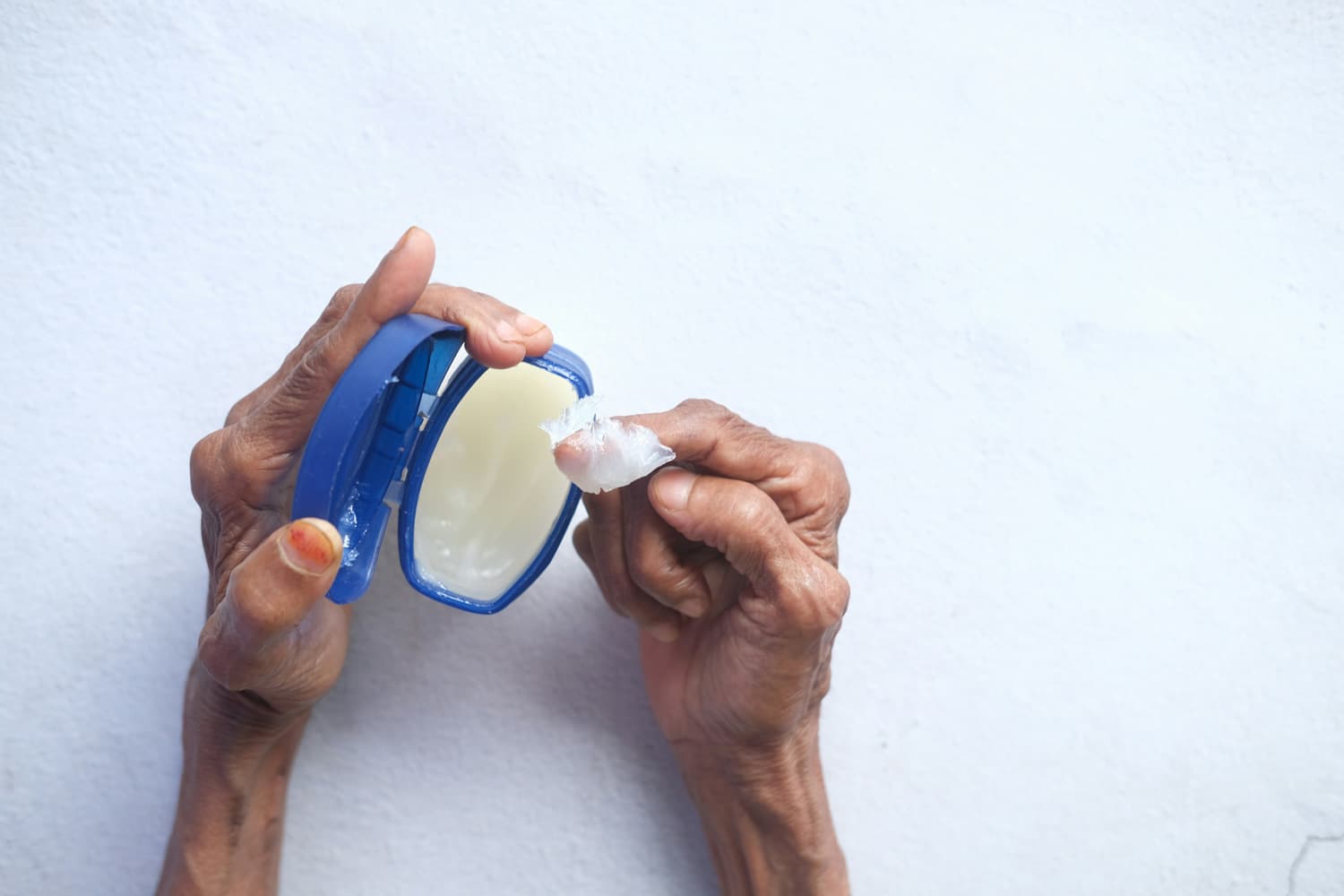
What’s your first instinct when you get a minor cut or burn? Do you run it under cold water? Soothe it with aloe vera gel before covering it with a bandage? Or do you reach for a distinct beige jar with a blue lid and put petrolatum on it?
Petrolatum—also known as “petroleum jelly” and often referred to by the brand name Vaseline—is typically used to moisturize and protect skin. As its name suggests, petrolatum is derived from petroleum, specifically from a by-product of refining crude oil into diesel, gasoline, kerosene, or jet fuel.
After petroleum is extracted from an oil field through drilling, it is passed through heated distillation towers that separate the oil into lighter energy products and residue. The residue then has impurities removed—including asphalt, sulphur, heavier oils, and wax—before finally being filtered through bauxite to produce petrolatum.

From rod wax to Vaseline
The discovery of petrolatum is often credited to American chemist Robert Augustus Chesebrough in 1859—although there are records of Indigenous peoples in North America like the Seneca and the Haudenosaunee using petroleum for skin and health care at least a century earlier. Chesebrough’s early career consisted of distilling kerosene for lamps from sperm-whale oil. When the discovery of an oil field in Titusville, PA, led to an oil rush that threatened Chesebrough’s job, he decided to visit. There, he came across a black, waxy residue the workers called “rod wax.” They were constantly scraping it off their drilling and pumping equipment and also used it to treat wounds and burns.
Chesebrough collected samples of the wax to take back to his lab in Brooklyn, NY. He experimented on it until he discovered that by filtering the wax through bone-black—a porous charcoal—he could produce a thick, pasty substance that could soothe chapped hands and also worked as a hair pomade, machine lubricant, and leather polish.
In 1870, Chesebrough opened a factory in Brooklyn to manufacture “a new and useful Product from Petroleum” that he named Vaseline—reportedly a portmanteau of wasser (German for “water,” pronounced VA-ssa) and ἔλαιον (Greek for “oil,” pronounced EH-lie-on)—and began selling it to customers. Chesebrough had patented the underlying process of manufacturing petroleum jelly in 1865 and went on to file another patent for further improvements in 1872.
He demonstrated Vaseline’s efficacy by burning himself in front of audiences.
Chesebrough reportedly traveled around New York to market Vaseline to customers. Historical accounts state that he demonstrated Vaseline’s efficacy by burning himself in front of audiences, applying Vaseline to the burn, and showing them sites of previous burns he claimed Vaseline had healed. The Vaseline website claims this tactic worked so well that a mere two years later, Chesebrough was reportedly selling over 1,400 jars a day.
“Chesebrough…later formalized and expanded operations by establishing the Chesebrough Manufacturing Company in 1880, as the product gained widespread success,” Karandeep Sandhu, associate brand manager for Vaseline Canada, wrote in an email to Asparagus. In 1955, the Chesebrough Manufacturing Company merged with cosmetics company Pond’s to become Chesebrough-Pond’s. In 1987, Unilever acquired Chesebrough-Pond’s and, by extension, the Vaseline brand.
Today, Vaseline products include the original petroleum jelly, a version including cocoa butter, as well as lip- and body-care products like lotions, body balms, lip balms, and hand and foot creams that all include petrolatum as a key ingredient.
Numerous other companies have also manufactured their own versions of petroleum jelly since Chesebrough’s patent expired in 1889. Yet the trademarked brand Vaseline has become synonymous with petroleum jelly.
Soft on skin
Petrolatum is a mixture of hydrocarbons, which means it is an organic chemical made up entirely of hydrogen and carbon atoms. Notably, it has not been chemically reproduced by combining hydrogen and carbon together, though it seems likely scientists have tried. Petroleum jelly typically comes in two forms: yellow and white, with the latter being further refined to remove carcinogenic polycyclic aromatic hydrocarbons (PAHs) and more commonly sold to consumers. Despite its name, white petrolatum is typically colourless, odourless, and has a thick, sticky consistency.
Since Vaseline first became available to consumers over 150 years ago, it has become a ubiquitous household item. It’s predominantly used to moisturize and protect skin, lips, and nails, especially if the skin is dry, flaky, irritated, or has minor cuts and/or burns. However, it can reportedly also be used to polish stainless steel, leather, and wood items, protect garden tools from rust, remove makeup stains from clothes and upholstery, and remove water rings from wood furniture. Vaseline is also sometimes used as an oral laxative and can potentially be used in ocular ultrasounds in lieu of ultrasound gel, which can irritate eyes.
The reason why Vaseline has become a ubiquitous household product is because it is “the most effective classic occlusive moisturizer,” according to Indonesian dermatology researchers. Human skin is made up of several layers. Water moves from deeper layers to the outer layers, hydrates them, and then evaporates—a process called “trans-epidermal water loss.” If the outermost layer does not retain water, it leads to build-up of dead skin cells called corneocytes, resulting in dry, flaky skin. A good moisturizer, then, ideally both helps replenish the skin’s moisture and slows its evaporation.
If petrolatum’s supply chain is disrupted, would we lose out on a valuable skin-care product?
Moisturizing skin-care ingredients typically belong to three categories: humectants, emollients, and occlusives. Humectants draw water from moisture in the atmosphere and bind it to the skin’s surface. Emollients are hydrocarbons that fill the gaps between skin cells to reduce the appearance of rough, dry, and flaky skin. Finally, occlusives are oils and waxes that form a water-resistant barrier on top of the skin to seal in existing moisture. They also protect the skin from environmental pollutants. Most moisturizers contain a mix of humectants, emollients, and occlusives.
Petroleum jelly is both an emollient and an occlusive and is significantly more effective at reducing trans-epidermal evaporation than other moisturizing ingredients like olive oil, lanolin, mineral oil, or silicone, according to a 1992 study. (Although a 2005 study reported that niacinamide, a synthetic form of vitamin B3, might do an equally good or even better job in soothing dry skin.)
Moreover, petrolatum is non-comedogenic, meaning it doesn’t clog pores. It also doesn’t cause burning or stinging, has a low allergenic potential (due to not containing preservatives), and has a long shelf life (due to the absence of water, which can develop bacterial growth). Although there have been concerns of petroleum jelly causing lipoid pneumonia—a build up of oils in the lungs caused by inhaling oils and fatty substances—this is avoidable by not applying it near the nostrils.
There have also been concerns that the PAHs sometimes used to refine the oil petrolatum is made from might render it carcinogenic, however, there is little to no evidence for this. As a result, petroleum jelly is considered the gold standard of occlusive skin-care ingredients and is often used to treat skin conditions such as dry or injured skin, eczema or atopic dermatitis, and contact dermatitis.
Hard on the planet?
While petrolatum itself hasn’t been found to harm the environment, it is nevertheless the byproduct of an industry that does. Petroleum jelly, as mentioned, is a byproduct of drilling into the ground to extract oil and gas. Depending on where the rig is located—on or off shore—the crude oil is then transported to a refinery through pipelines or in tankers, both methods of transportation that risk dangerous spills. The oil then undergoes distillation and further refinement, and is transported for consumption via pipelines, rail cars, or tank trucks, again risking spills.
This process of extracting, refining, and transporting oil is extremely costly: both literally—since oil rigs and refineries cost millions of dollars to build and maintain—and for the environment. Oil rigs disrupt wildlife, require a significant amount of water and energy to operate, and can cause environmental disasters such as spills, fires, explosions. Moreover, when consumed, the fuel they produce releases greenhouse gases into the atmosphere that are the main source of climate change. Even though petroleum jelly doesn’t cause these emissions, the process that produces it also produces them.
If petrolatum’s supply chain is disrupted—either due to an oil shortage (worst case scenario) or the world replacing oil with less harmful fuel sources (best case scenario)—would we lose out on a valuable skin-care product?
That question is hard to answer. Over the past few decades, oil has become a foundation of the global economy and foreign policy—demonstrated by numerous geopolitical events, such as the recent closure of the Strait of Hormuz. As a result, there is little transparency about global oil availability and a lot of institutional reluctance to transition away from oil as an energy source.
Experts and analysts have speculated about oil’s dwindling availability for decades; Shell geophysicist M. King Hubbert coined the term “peak oil” in the 1950s, hypothesizing that global oil production would peak before declining. However, the discovery of new oil reserves and technologies like hydraulic fracturing and horizontal drilling have allowed oil production to seemingly keep up with global demand.
Even though petroleum jelly doesn’t cause greenhouse-gas emissions, the process that produces it also produces them.
“From a supply perspective, refined petroleum derivatives remain widely available due to global refining infrastructure and long-term industrial demand,” wrote Vaseline Canada’s Sandhu. “As a result, there is no expectation that [Vaseline] would become unavailable in the foreseeable future.”
The problem then, as researchers at Imperial College London put in a 2020 paper, “seems not to be that we cannot continue using oil, but that perhaps we should not” due to its colossal carbon footprint and contribution to climate change. Divesting from oil has become a politicized—and polarized—issue, with many governments reversing climate policies and investing in fossil fuel infrastructure.
Experts such as economist Ryan Kellogg nevertheless deem it “plausible” to envision that “global demand for crude oil falls to essentially zero by the end of this century, driven by improvements in clean energy technologies, adoption of stringent climate policies, or both.” And if the demand for crude oil declines, it seems reasonable to assume the Vaseline supply would likely decline as well. So, what could we use in its stead?
Many common moisturizer brands—including Aveeno, Nivea, Cerave, and Cetaphil—already use glycerin, dimethicone, mineral oil, and/or paraffin as occlusives instead of white petrolatum. On Canadian drugstore shelves today, mostly only Vaseline products seem to use petroleum jelly as an occlusive. The effect of petroleum jelly is hard to replicate, however, as it is less irritating to skin—especially facial skin—than its counterparts.
Given the ongoing global dependence on fossil fuels, the need to replace petroleum jelly is at minimum decades away. But the story of petrolatum reminds us of the many surprising ways this harmful industry is woven into our lives.
This story was first published on The Green House, our membership platform. Join us there for early access, discounts and freebies, community discussions, and to support our work telling the large and small stories of how we can live sustainably.