Wildflower Seed Libraries Sprout Across Canada
From roots in Ottawa, a movement to share native-plant seeds is spreading nationwide.

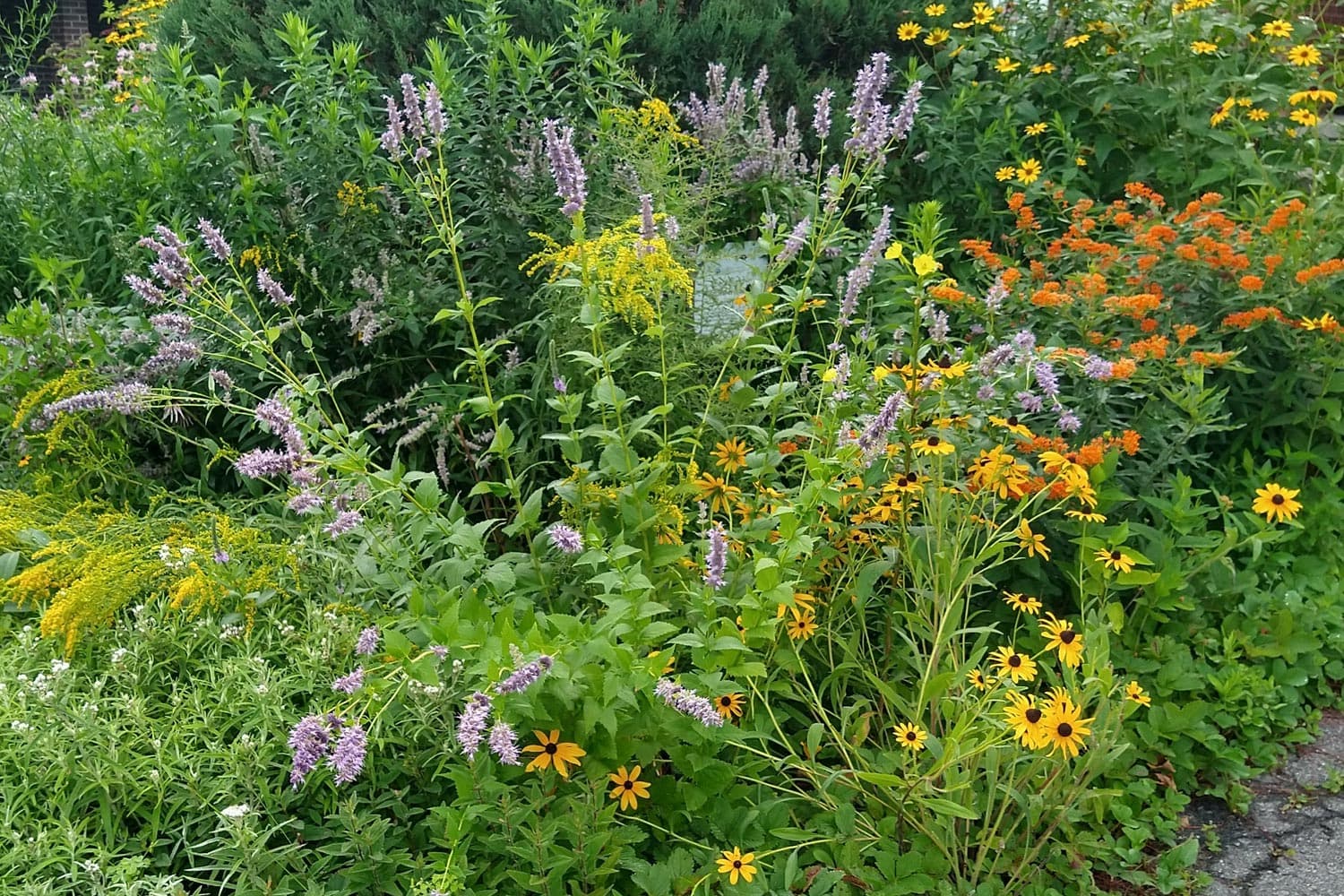
Wildflowers—including black-eyed Susan, butterfly milkweed, goldenrod, hyssop, and pearly everlasting—bloom in an Ottawa garden.
When Mélanie Ouellette began sharing native wildflower seeds from her Ottawa home in 2020, she had a lot on her mind. It was the first year of the Covid-19 pandemic, and she was itching for a project to keep her busy outside her work as a manager at Engineers Canada.
“I wanted to address climate change,” she shares. “I wanted to foster Indigenous reconciliation. I also wanted to empower women to become leaders in our community.” She was further motivated after watching an online lecture by Robin Wall Kimmerer, author of the Indigenous ecology book Braiding Sweetgrass. Kimmerer spoke about the value of engaging in local activities and following your passions. “So I thought, what was something I could do that would help with all these three issues? Plus, what is something I can do that I don’t get tired of?” She could only think of one thing: gardening.
The project she came up with is the Ottawa Wildflower Seed Library, and it is blossoming at an impressive rate. Ouellette shares that from the fall of 2025 to February 2026, the library distributed 200,000 packets of 265 different seed varieties. And the library’s success is an inspiration to other communities starting native seed projects.

The library—which appears to be the first of its kind in Canada—is a free community resource. Its goal isn’t to stockpile or protect certain seeds, like a seed bank, but instead to ensure that as many people as possible can access native wildflower seeds easily. It started with a small Facebook group and “basically me packing seeds,” says Ouellette. She and her friends collected the first seeds and Ouellette mailed out about 200 packets in the first year. Within a few years, over 100 volunteers were helping her out, and “We’re packing seeds like crazy.”
The seeds are now distributed through a mix of events, educational facilities, and mailouts. Ouellette and her team have given presentations and distributed seeds—which are packaged in tiny envelopes homemade from upcycled paper—at libraries, schools, community centres, and plant swaps. They also have shipped seeds to organizations and individuals who can’t make it to events. At seed-packing days, volunteers and those curious about the organization gather to organize and prepare seeds, and those donating seeds can drop them off. All events are advertised through social media and the library’s newsletter.
Participating in plant swaps keeps the seed library especially busy in spring, but activities take place year round. Winter’s a great time for presentations and demonstrations, as that’s when native seeds are typically prepared for cold germination. (Also known as “cold stratification,” this process exposes seeds to cold, moist conditions so they’re ready to sprout in spring.) Beginner gardeners can take comfort in the fact that each seed package includes pertinent information about when and how the seeds should be planted.
Ouellette says black-eyed Susans (Rudbeckia hirta) are among the library’s most popular seeds. Bright-coloured cardinal flower (Lobelia cardinalis) and its cousin great blue lobelia (Lobelia siphilitica) are also big crowd pleasers. However, the available seeds include varieties the casual gardener might not know, including hairy beardtongue (Penstemon hirsutus), swamp rose-mallow (Hibiscus moscheutos), and pearly everlasting (Anaphalis margaritacea).
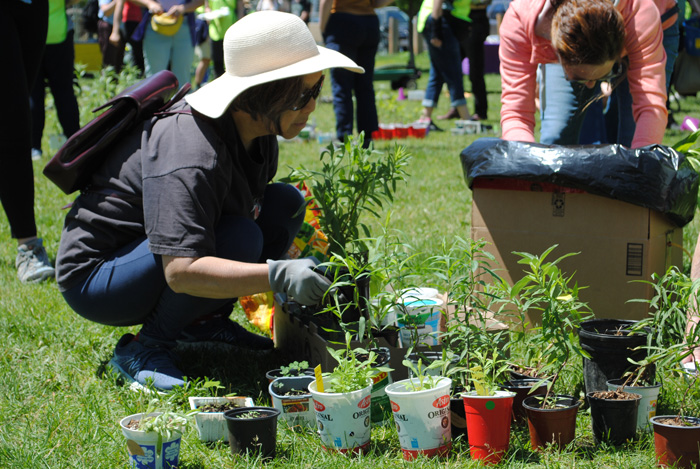
A gardener considers the options at an Ottawa plant giveaway.
Those free seeds create more than pretty flowers. They’re a gateway for combating climate change at a community level. “We get … people in using the free stuff,” Ouellette says. “Once they have the seeds, and they see that the seeds have been collected and packed with a lot of love from a lot of volunteers, they feel the significance.” Established native plants have little need for watering or (often fossil-fuel-derived) fertilizer and pesticides. Maintenance is low but rewards are high.
The excitement of seeing a native plant in action is often the spark people need to reexamine their ecological relationships. “When I speak about Indigenous reconciliation,” she says, “that means also decolonizing our perspective of nature… We are part of nature. We’re not separate from it.”
Even a single plant can make a difference, something Ouellette has observed in her own garden, where wildflower plantings immediately attracted butterflies she hadn’t seen there before, like monarchs. In a 2024 lecture she gave through the David Suzuki Foundation, Ouellette shared that one way to decolonize urban areas is “reintroducing what belongs to the land we occupy.”
Ouellette has received guidance and encouragement from Matthew Oliver, a professional colleague who is Red River Métis from Selkirk, MB. Ouellette credits his teachings as integral to the seed library’s establishment, in particular the idea that it should be a library that the community gives back to—whether contributing seeds or their time—not just a seed giveaway.
On Ouellette’s majority-woman team of about 100 volunteers, everyone is welcome. “This is joyful work!” she says. It’s also inclusive work—by design. “The activities we do are very accessible for anybody that has any type of physical or mental difference. We are so flexible, and we’re so grassroots that we can help everybody participate to the best of their abilities.” Volunteer roles range from doing short-term tasks like packaging seeds, driving them to events, or contributing baked goods, to ongoing board positions.
The strong volunteer base serves as a balm during difficult times. “I think the biggest threat [from] climate change is for people that care to get discouraged,” says Ouellette. “To not get discouraged, we have to act as a community and … hang out with like-minded people.”
Free seeds are a gateway for combating climate change at a community level.
What about taking the Ottawa Wildflower Seed Library national to spread its positive effects further afield? By the very nature of the seed library’s work, that’s impossible. Seeds that are native to Ottawa likely aren’t native to Prince Edward Island or BC. It’s not possible to talk about native “Canadian” seeds when the country covers multiple climate zones and endless variations in topography.
A more realistic hope is for each city or region to create its own wildflower seed library or similar program. It’s starting to happen. One example is underway at Douglas College in BC, where the Institute of Urban Ecology operates a seed library out of the college’s Coquitlam campus. They’re sourcing many of their seeds from pollinator-friendly flowers, native non-invasive species, drought-tolerant plants, wildlife-friendly habitat, and an on-site sacred Indigenous medicinal garden. They also host monthly public workshops on topics ranging from Indigenous herbal medicine to companion planting. Members of the public are encouraged to email the institute to receive a list of currently available seeds and instructions on how to receive them.
Ouellette shares that organizers in Moncton, NB, and Thunder Bay and Durham, ON, have also been working on native seed projects. Her organization is ready to support more groups, having created a section of their website to help others keen to replicate their success. Much like the seeds themselves, you never know where this idea might spread.
Ouellette believes people are attracted to the seed library and native seeds because “they can’t control the world, but they can control their little piece of the land. And they can control helping other people.” For anyone doubting whether a tiny seed can make a difference in these uncertain times, there’s only one way to find out. “The seeds,” says Ouellette, “they’re small but they’re very mighty.”
This story was first published on The Green House, our membership platform. Join us there for early access, discounts and freebies, community discussions, and to support our work telling the large and small stories of how we can live sustainably.