BC’s Glass Sponge Ecosystems Are Important and In Danger
These ancient reefs sink carbon, protect biodiversity, and filter water, but they’re under threat from fishing and climate change.

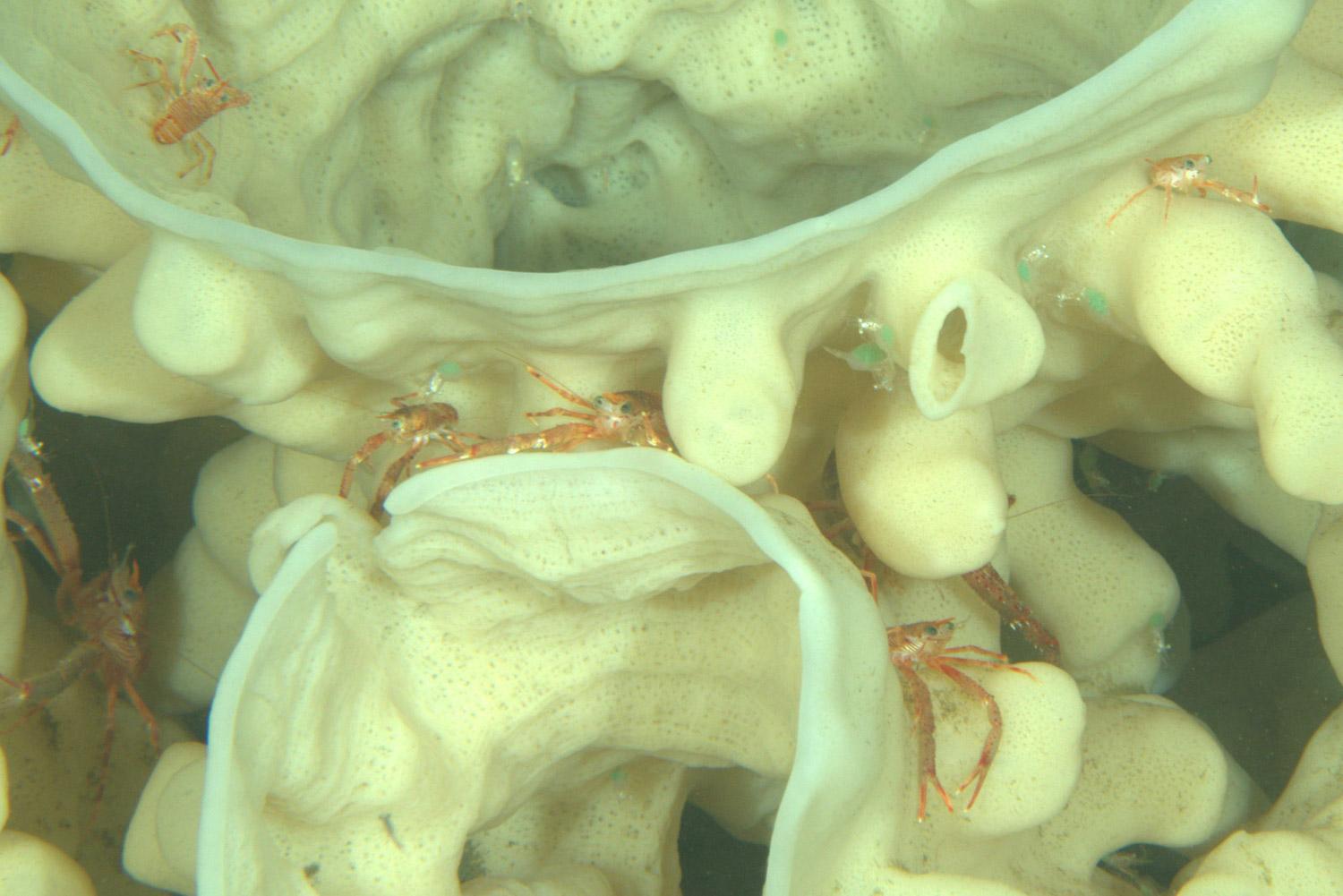
Squat lobsters shelter in the glass structure of a fingered goblet sponge.
When you think of the word “nursery,” you probably don’t envision an intricate biostructure made of glass. Just as corals form massive reefs spanning kilometres across the seafloor of all the world’s oceans, in the Northeast Pacific—mostly off the BC coast—sponges made of glass do the same, providing critical habitat where fish, prawns, and squat lobsters feed, lay their eggs, and shelter their young from predators.
Glass sponge reefs provide habitat to several species, and are biologically unique in the way they live, feed, and grow. They are extremely productive in sinking carbon and are invaluable in their efficacy at cleaning our waters. But these organisms are dually under threat from commercial fishing and climate change.

What is a glass sponge?
Imagine a thousand tiny shards of glass interlaced into a 3D skeleton delicate as a sugar cube; that is what a piece of glass sponge feels like in your hand. (If you’re local to Vancouver you can see one on display in the Marine Invertebrate Collection at the Beaty Biodiversity Museum). The body of glass sponges are made up of thousands of silica (glass) spicules fused together and embedded through a large network of tissue called syncytial tissue. Syncytial tissue is multinucleated, meaning it doesn’t contain individual cells with distinct membranes but is a continuous cytoplasmic mass supported by the sponge’s intricate glass skeletal framework.
Having one continuous mass of tissue helps the sponge “propagate electrical signals very quickly through their whole bodies,” explained Dr. Anya Dunham, a research scientist at Fisheries and Oceans Canada, in a video call. These electrical signals alert the sponge when the water has an overwhelming amount of sediment in it so it can cease feeding.

A glass sponge reef on the Hecate Strait seafloor—made up of F. occa (paler) and fingered goblet sponges (more yellow)—is home to many species of marine life.
In the three known reef-building species—Heterochone calyx, Aphrocallistes vastus, and Farrea occa—structures built from interconnected spicules can extend for hundreds of kilometres and grow to be 25 m high. Each species of reef-building glass sponge has also been found living in solitary form, or in small groups referred to as sponge gardens. The difference between a reef and a garden is that, in a garden, the sponges are separate but near each other, whereas in a reef they are interconnected across the whole structure.
According to research published by marine geologist Kim Conway and others, it is possible that glass sponge reefs were once the largest bioconstruction on the planet. Based on the fossil record, they may also be among the oldest lineage of animals alive today. As far as we know, they form reefs exclusively in the Northeast Pacific.
Ancient but not extinct
While there are several species of glass sponge in the deep ocean, the reef-building species were thought to be extinct until the late 1980s, when living reefs in Queen Charlotte Sound and Hecate Strait were discovered by a team of scientists who were mapping the continental shelf for Natural Resources Canada. Using sonar, Conway and his team stumbled upon mysterious formations so diverse in size and shape that they didn’t immediately realize they were related, and certainly didn’t expect them to be reefs of believed-extinct sponge species.
Around the same time, while researching his book Diving Howe Sound Reefs and Islands, scuba diver, citizen scientist, and engineer Glen Dennison noticed similar structures in the waters along BC’s Sea to Sky Highway from West Vancouver to Squamish. “It’s like no other type of diving that you’ve done in BC,” Dennison told me in a phone interview. “It looks like a Dr. Seuss garden down there.”
With towering finger-like protrusions and cup shaped formations, Heterochone calyx is commonly known as the fingered goblet sponge. Aphrocallistes vastus gets the common name cloud sponge from its shapes reminiscent of clouds or cotton candy. The most northern species, Farrea occa, has no common name, but the occa in its Latin name translates to “harrow,” a toothed farming tool. Goblet sponge and cloud sponge are both found in Howe Sound and the Strait of Georgia, but F. occa “seems like it needs to be further north to be happy” says Dunham. She says it has been found building reefs only in Hecate Strait and Queen Charlotte Sound to date.
Scientists have a few theories as to why these sponge reefs seem to only occur off the west coast of North America. Over the course of my conversations with Dunham, she told me this may be due to these waters being particularly rich in silica. Sources include glacial substrates in the fjords; silicate-rich volcanic rocks on-shore that get weathered by rainfall (this run-off is then carried into the ocean by rivers); and seasonal upwelling that causes silica-rich water to rise from the deep sea.
Key environmental functions
Dunham refers to the glass sponge reefs as “islands of biodiversity on the seafloor” because of the unique habitat and food source they provide to species living on and around them. (It has been discovered that some species of seastar munch on the spicules.) Damage to these ecosystems threatens the species that rely on them for food, shelter, and nursery habitat.
Apart from their importance in maintaining the food web of the ocean, glass sponge reefs play a key role in environmental health and water quality. In fact, as suspension feeders, they are extremely efficient at filtering large amounts of seawater and removing organic particles and bacteria from the water column. It is estimated that a glass sponge can filter up to 9,000 L of water per day—compare this to an oyster, another highly efficient filter feeder, which hits its limit at 200 L per day. Dunham told me that if the sponge reefs had access to the entire volume of water in the Strait of Georgia and Howe Sound, they would be able to turn the whole volume over three times in a year.
Keeping the fishermen off the reefs is a win-win for everyone, because they act as a nursery for the prawns.
Scientists are constantly learning new and surprising things about our oceans. One such discovery—in new, not-yet-published research co-authored by Dunham—is that glass sponge reefs sequester large quantities of carbon—known as blue carbon when it’s captured by the ocean. “We didn’t know how much they actually put away into the sediment on geological timescales,” said Dunham. Comparing them to nearshore ecosystems like seagrasses and kelps, she added, “They’re actually doing it more efficiently than coastal ecosystems, which is very exciting, because this is the first time we are recording something like this in the deep sea.”
Dual threats: climate and fishing
The sponges provide many benefits to their environment, but they grow at a very slow rate. “Probably millimetres to centimetres a year, if that,” says Dunham. This slow growth is one of many reasons why glass sponge reefs are at risk from both climate change and fisheries.
The integrity of the sponge’s structure appears to be weakened by both rising temperatures and ocean acidification, which is caused by excess carbon dioxide from the atmosphere being absorbed by the ocean, changing its chemistry. And even the slightest interaction with fishing gear—including nets, trawls, anchors, and prawn traps—can cause significant damage that takes an exceptionally long time to recover from, if recovery is possible at all. In order for glass sponges to form a reef structure, larvae rely on the intact skeletal remains of dead sponges. Damage to reefs therefore also prevents new sponges from growing due to the lack of a strong foundation of adult sponges under them.
Prior to 2017, commercial fishers suggested that damaged reefs had died of natural causes. But from 2017–19, Dunham and her team conducted core sampling tests, which involved removing a cylindrical sample from sponges to analyze their growth rate, age, and health. These tests showed that the reefs had all died within the last 70 years, “point[ing] the finger to humans pretty clearly,” she says. “The study showed us that different fishing gear does different degrees of damage, but none appears to be totally safe.”
During our interview, Dennison and I discussed the damage humans do to the reefs in order to acquire commercially important species. He shared an insight his daughter had when researching glass sponge reefs: “Keeping the fishermen off the sponge reefs is actually a win-win for everyone, because they act as a nursery for the prawns.” He added, “You can’t damage one species to be feeding another one… This is about protecting one of the most valuable ecological systems in the world.”
Protecting the reefs
As of November 2026, glass sponge reefs have been assessed as Vulnerable under the International Union for Conservation of Nature Red List of Ecosystems. Raising public awareness about the presence of glass sponge reefs in our waters is an important cornerstone in ensuring their protection. Not everyone who damages the ocean is doing it with intent or for lack of care. Sometimes, even people who love the ocean end up causing damage. Some glass sponge reefs are at recreational diving depths, meaning they are accessible to anyone with the means to scuba dive. Collecting a piece of glass sponge without knowing the significance of these organisms and their slow recovery rate creates dangers for the reef.
Additionally, sediment stirred up by divers’ fins and gear can overwhelm the sponges. Dr. Sally Leys, from the University of Alberta, did a study showing that when sponges have too much sediment in them, they actually have an ability to expel irritants in a way similar to a cough or sneeze. However, that ability is limited, and Leys’ research shows they can become overstressed and die if the amount is too great.

Citizen scientist Glen Dennison scuba dives over a cloud sponge reef in Howe Sound, BC.
Glass sponge reefs are unique in their way of life, fascinating in their biology, delicate yet resilient, and have so much left to teach us about the Northeast Pacific Ocean. So how do we protect these ancient ecosystems? The answer is complex, but Marine Protected Areas are one strategy that is effective at protecting reefs from trawling and fishing. However, Dunham explained in an email that “non-compliance with protected area regulations remains an issue.”
For both Dennison and Dunham, bringing awareness to the existence of the reefs is an integral part of conservation. They want people to know what is living in the ocean, and understand the ecology and relationships—that each species is not isolated from others.
Beyond the important role these ancient organisms play in maintaining our food supply and cleaning our water, protecting them for the sake of themselves and the health of the ocean is just as significant. Dunham makes the point that “parts of the ecosystem that have been there for centuries are clearly meant to be.”
This story was first published on The Green House, our membership platform. Join us there for early access, discounts and freebies, community discussions, and to support our work telling the large and small stories of how we can live sustainably.